
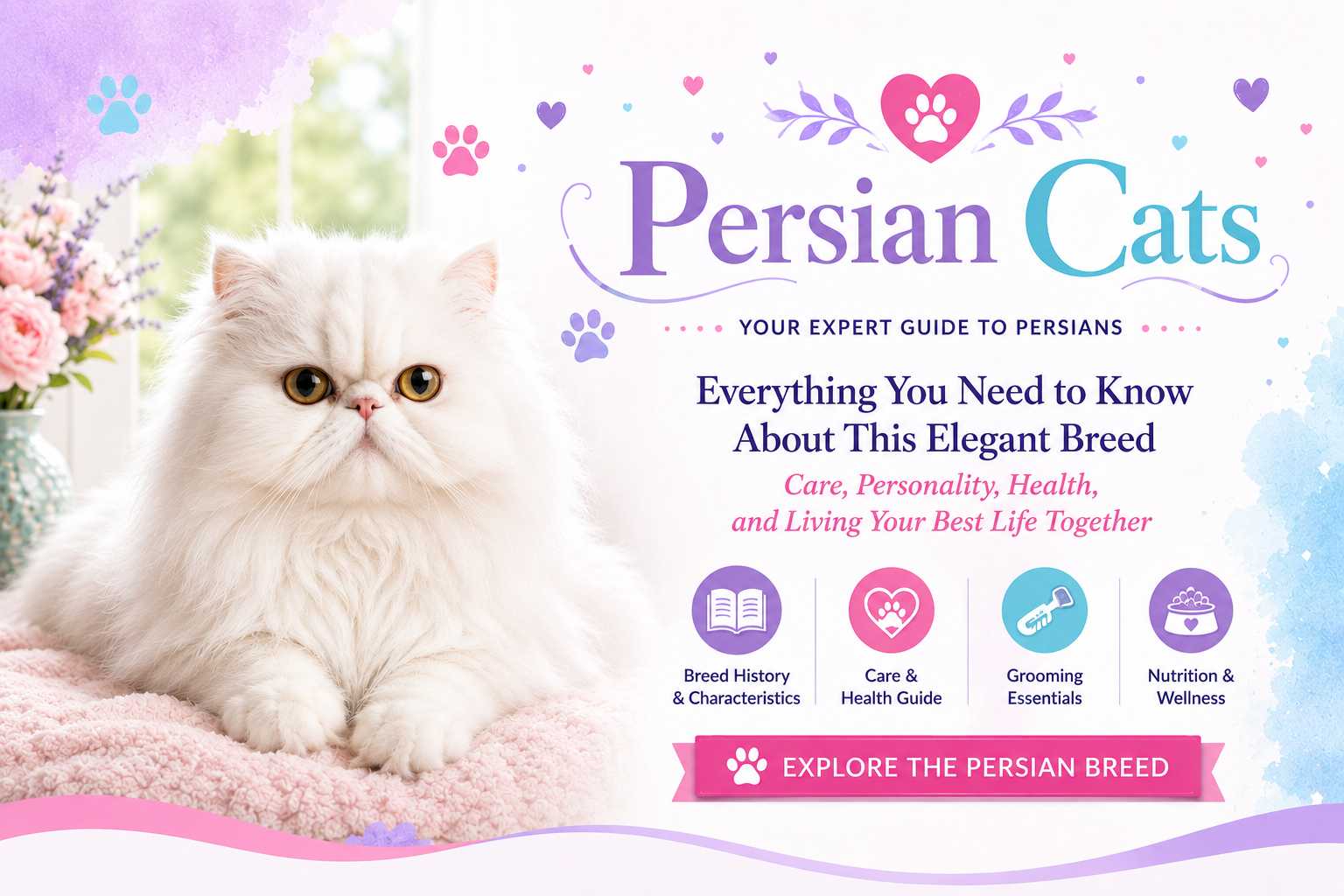
Persian Cats: The Complete Guide to the Persian Cat Breed
Few cats are as instantly recognizable as the Persian cat. Beneath that extraordinary coat and round, expressive face is a generally gentle, quiet companion who often prefers a peaceful household, predictable routines and affection delivered without too much commotion. But the Persian is not simply a decorative cat. This is a breed with substantial daily grooming needs, important inherited-health considerations and facial conformation that deserves an honest welfare discussion.
If you are considering a Persian kitten, adopting an adult Persian, or already share your home with one, this guide is designed to answer the questions that matter in real life: personality, grooming, shedding, food, health, lifespan, colors, cost, breeders, rescue, kittens, senior care and whether the breed actually suits your household.
Persians can be wonderful companions for the right person. The key phrase is the right person. Their calm personality can be easy to live with; their coat is anything but low-maintenance.
Persian Cat at a Glance
| Personality | Gentle, quiet, affectionate, calm and often routine-loving |
|---|---|
| Activity level | Low to moderate; playful in shorter bursts |
| Typical adult weight | Often around 7–13 lb (3.2–5.9 kg), with individual variation |
| Coat | Long, dense and high-maintenance |
| Grooming | Daily combing is normally required |
| Shedding | Yes; substantial coat means substantial loose hair |
| Hypoallergenic? | No cat is truly hypoallergenic; Persians are not considered a low-allergen breed |
| Vocalization | Usually relatively quiet, often with a soft voice |
| Apartment suitability | Often very good when environmental needs are met |
| Children | Often best with gentle, respectful children |
| Other pets | Can live successfully with compatible cats and calm dogs after careful introductions |
| Important health concerns | PKD, brachycephalic-related breathing/eye/dental problems, coat and skin problems; other risks vary by line |
| Best suited to | People who want a calm indoor companion and genuinely enjoy—or will reliably provide—daily grooming |
Persian reality check: The personality may be laid-back. The maintenance schedule is not. Anyone considering this breed should regard coat and face care as routine husbandry, not occasional beauty treatment.
Persian Cat History & Origin
The Persian is one of the historic longhaired breeds that helped shape the modern cat fancy. Its precise ancestry is more complicated than the name suggests. The Cat Fanciers’ Association notes that in 1626 Italian traveler Pietro della Valle returned from Persia with a heavily coated longhaired cat that differed from the Turkish Angora arriving in Europe around the same period. Longhaired cats were subsequently selectively bred, and the Persian type became increasingly established.
Persians were among the cats exhibited during the early development of organized cat shows. They also became foundational to the North American cat fancy: CFA identifies the Persian as one of its six foundation breeds when the association began in 1906.
Over generations, selective breeding changed the breed’s appearance. Today’s show Persian has a much shorter muzzle and flatter facial profile than the less extreme longhaired cats seen historically. That change matters because appearance and health cannot be discussed separately in a brachycephalic breed.
The breed’s enormous color variety also reflects a long history of selective breeding. Persians can be solid, tabby, tortoiseshell, calico, bicolor, smoke, shaded, silver, golden or pointed, among many recognized combinations.
Breed Recognition, Himalayans & Persian Terminology
Major registries recognize the Persian, but classification details are not identical everywhere. This explains why apparently simple questions such as “Is a Himalayan a Persian?” can produce different answers.
In CFA competition, Himalayan-pattern cats are included within the Persian breed as the Himalayan division. Other registries may organize closely related breeds or varieties differently.
Common Terms You May Encounter
- Persian: the recognized longhaired breed.
- Himalayan: a Persian-type cat with the colorpoint pattern and blue eyes; registry treatment varies.
- Chinchilla Persian: commonly used for a very lightly tipped silver Persian; “Chinchilla” describes a color variety, not a separate species of cat.
- Doll face Persian: an informal term generally used for a Persian with a less extreme facial profile.
- Traditional Persian: another informal term often used for less extremely flattened facial structure.
- Peke-face: a term associated with an extremely shortened facial appearance; it should never be interpreted as a health guarantee or a reason to favor more extreme anatomy.
- Teacup, miniature or toy Persian: marketing terms, not standard Persian size varieties recognized simply because a seller uses the label.
When researching a kitten, concentrate on health, temperament, pedigree, genetic screening, veterinary care and the breeder’s practices—not fashionable labels.
Explore more breeds in the Cats Central Cat Breeds & Types Guide.
Persian Cat Appearance, Size & Weight
A Persian is a compact, substantial cat underneath all that hair. The breed standard calls for a heavily boned, well-balanced body with short, thick legs, a broad round head, large round eyes, small ears and a relatively short tail carried in proportion to the body.
The coat creates an impression of even greater size. Once wet during a bath, a Persian can reveal rather dramatically how much of the visual spectacle was fur.
How Big Do Persian Cats Get?
Persians are generally medium-sized, though males are commonly heavier than females. PetMD gives a broad adult range of roughly 7–13 pounds. A large UK veterinary-record study of 3,325 Persians reported an average adult weight of 3.9 kg (about 8.6 lb), with males averaging 4.3 kg and females 3.4 kg.
Those figures are useful reference points, not target weights for every cat. Body condition matters more than forcing an individual Persian to match an online number.
Body Type
The Persian is described as “cobby”: relatively short and broad-bodied rather than long and athletic. Heavy bone, short legs and a broad chest contribute to the sturdy silhouette.
Do not confuse a naturally substantial build with obesity. The ribs should not disappear beneath a layer of excess fat just because the coat makes visual assessment difficult.
Doll Face, Traditional & Flat-Faced Persian Cats
“Doll face Persian” is a popular search term, but it is not a magic health category. It is generally used by breeders or owners to describe Persians with a more projecting nose and less extreme facial flattening than the modern show type.
Similarly, traditional Persian usually refers informally to a less extreme facial appearance. Exact usage varies, so ask to see the actual cats rather than relying on terminology.
What About Flat-Faced Persians?
Persians are brachycephalic, meaning the skull is shortened. Greater facial shortening can be associated with welfare problems involving breathing, eyes, skin folds, tear drainage and dental crowding. The Governing Council of the Cat Fancy specifically notes that the modern shortened face and nose may contribute to breathing, skin and eye problems.
Do not choose the most extremely flattened kitten because someone tells you that a dramatic face is “better quality.” A responsible breeding goal should include a cat who can breathe comfortably, maintain healthy eyes, eat normally and enjoy ordinary feline life.
Appearance should never outrank function.A Persian’s face can be round and recognizably Persian without treating noisy breathing, chronically irritated eyes or severely distorted anatomy as desirable breed features.
Persian Cat Coat, Colors & Patterns
The Persian’s coat is one of the most elaborate in the cat world: long, dense and full, with a prominent ruff around the neck and a plumed tail. It requires regular human maintenance because a cat cannot reliably keep this volume of coat free of tangles and mats alone.
Color variety is extraordinary. CFA organizes show Persians into divisions that include solids, silver and goldens, shaded and smokes, tabbies, parti-colors, calicos and bicolors, and Himalayans.
Persian Colors Include
- White
- Black
- Blue
- Red
- Cream
- Chocolate
- Lilac
- Silver and golden varieties
- Smoke and shaded varieties
- Tabby patterns
- Tortoiseshell and blue-cream
- Calico and bicolor combinations
- Himalayan/colorpoint patterns
Eye color is associated with particular show color divisions and can include copper, blue, green/blue-green or odd eyes depending on coat variety.
Popular Persian Cat Colors: White, Black, Blue, Tortoiseshell & Chinchilla
Ubersuggest data supplied to Cats Central shows substantial interest in Persian colors, especially tortoiseshell, white, black, blue, calico and Chinchilla Persians. Color changes the appearance dramatically, but it does not create a different personality breed.
White Persian Cat
A white Persian has a pure white coat and may have copper, blue or odd eyes under CFA standards. White coat color should not be confused with albinism. Blue-eyed white cats can have an increased risk of congenital deafness, so hearing status is worth discussing with a veterinarian or breeder.
Black Persian Cat
A black Persian can look almost sculptural when the coat is in full condition. CFA’s ideal is a dense black coat through the roots without a rusty cast. In household life, coat condition, nutrition and sun exposure can affect appearance.
Blue Persian Cat
“Blue” in cat terminology means a diluted gray tone, not blue in the crayon-box sense. Blue Persians are one of the classic solid colors.
Tortoiseshell Persian Cat
Tortoiseshell Persians combine dark and red-based areas in a mottled or patched effect. Because the genetics of orange coloration are sex-linked, tortoiseshell cats are overwhelmingly female, although rare male tortoiseshells occur.
Calico Persian Cat
Calico Persians combine white with red-based and dark-colored patches. Like tortoiseshells, calicos are overwhelmingly female because of the genetics involved.
Chinchilla Persian
A Chinchilla silver Persian has a white undercoat with very light black tipping that produces a sparkling silver effect. The dramatic dark eye and nose lining adds to the characteristic appearance. “Chinchilla” here describes a Persian color variety; it is not a Persian crossed with the unrelated chinchilla rodent.
Because Persian color terminology is extensive enough to deserve its own visual resource, see our growing Persian Cat Colors & Patterns Guide.
Do Persian Cats Shed? Are Persian Cats Hypoallergenic?
Yes, Persian cats shed. A long, dense coat produces loose hair, and routine combing helps remove it before it becomes part of the furniture, clothing or a mat in the coat.
Seasonal changes, indoor climate, health, nutrition and the individual cat can influence shedding. Sudden hair loss, bald patches, excessive itching, skin lesions or a major coat change deserve veterinary attention rather than being dismissed as “Persian shedding.”
Are Persian Cats Hypoallergenic?
No. Persian cats should not be marketed as hypoallergenic. Cat allergy is usually a reaction to allergenic proteins produced by the cat, not simply to long hair. Fur and dander can distribute allergens around the environment.
A person with cat allergies should spend meaningful time around the individual cat before adoption when possible and discuss significant allergy concerns with a qualified medical professional. Coat color, including white, does not make a Persian reliably hypoallergenic.
Read our Hypoallergenic Cat Breeds guide for a more complete explanation of cat allergens and realistic expectations.
Persian Cat Temperament & Personality
Persians are generally known for being gentle, quiet and easygoing. TICA describes them as placid cats that often enjoy lounging with their families, while still having occasional bursts of playful activity.
In ordinary household terms, many Persians are more likely to appreciate a comfortable window perch and an evening beside you than to spend the afternoon scaling the curtains. That does not mean they should live without exercise or enrichment.
Are Persian Cats Affectionate?
Many are. Affection may be expressed through sitting beside a favorite person, resting on a lap, sleeping nearby, following familiar routines or asking quietly for attention. Individual personalities vary, and not every Persian wants constant handling.
Are Persian Cats Calm?
Generally, yes. Their reputation as a calm breed is deserved, but “calm” should not be translated as inert. Healthy Persians need play, exploration and opportunities to perform normal feline behaviors.
Do Persian Cats Like to Be Held?
Some do; some tolerate it; some would prefer that humans admire them without rearranging them. Early gentle handling helps, but respect the individual cat’s body language.
Are Persians Good First Cats?
Temperament-wise, they can be. Maintenance-wise, they are not the easiest beginner breed. A first-time owner who is organized, financially prepared and committed to daily grooming may do very well. Someone looking for a wash-and-wear cat should choose another breed.
Learn more about feline communication in our Cat Behavior section.
Persian Cat Intelligence, Learning & Training
Persians are intelligent cats, although their style can be less conspicuously busy than highly active breeds. They can learn household routines, names, carrier training, grooming routines and simple behaviors through positive reinforcement.
Useful Things to Teach a Persian
- Coming voluntarily for grooming
- Accepting paw handling and nail trimming
- Entering a carrier without a battle
- Standing or sitting on a grooming surface
- Accepting gentle face cleaning
- Coming when called
- Using appropriate scratching surfaces
Short sessions work well. Reward cooperation with something the individual cat values—food, play, affection or access to a favorite activity.
Never punish a cat for resisting painful grooming. If combing suddenly becomes difficult, investigate mats, skin problems, arthritis or another reason handling may hurt.
Persian Cat Exercise, Play & Enrichment
Persians tend to have low-to-moderate activity levels, but they still need daily movement. Regular play supports muscle, healthy body weight, mobility and mental wellbeing.
Good Persian Cat Activities
- Short interactive wand-toy sessions
- Chasing lightweight balls or toy mice
- Food puzzles adjusted to the cat’s ability
- Window watching
- Low-to-moderate climbing structures
- Exploring boxes and tunnels
- Gentle training games
For a brachycephalic Persian, exercise should never produce obvious respiratory distress. Open-mouth breathing in a cat is not normal post-workout panting to shrug off; it warrants prompt veterinary attention, especially if breathing appears difficult.
Our Indoor Cat Enrichment guide has additional ideas for creating a more interesting home.
Persian Cat Grooming: The Non-Negotiable Part
If one subject deserves extra depth in a Persian guide, it is grooming. Supplied keyword data shows strong search demand for Persian grooming and grooming tools, and for good reason: the breed’s coat needs consistent maintenance.
Plan on combing a Persian every day. TICA and CFA both emphasize regular/daily coat care because tangles can become mats. Mats are not merely unattractive. They pull on the skin, can hide irritation and may become painful.
A Practical Persian Grooming Routine
- Check the coat daily. Pay special attention behind the ears, under the front legs, chest, belly, trousers and other friction areas.
- Comb to the skin carefully. Running a brush only over the surface can leave developing tangles underneath.
- Work small tangles early. Do not yank through a mat.
- Check the face and eyes. Facial anatomy can make tear overflow and staining a recurring issue.
- Check the rear coat. Long hair can become soiled and may need hygienic trimming.
- Monitor skin. Look for redness, scaling, odor, sores, parasites or unusual hair loss.
Do Persian Cats Need Baths?
Some Persian owners and show-cat caregivers bathe routinely because the dense coat can become oily and difficult to manage. The appropriate frequency depends on the cat, coat, lifestyle and health. A veterinarian or experienced cat groomer can help establish a safe routine.
Any bath should be followed by thorough, safe drying. Mats should be addressed before bathing because water can tighten existing tangles.
Should You Give a Persian a Lion Cut?
A lion cut is sometimes used when a coat has become severely matted or for individual medical/grooming circumstances, but shaving is not a substitute for routine coat care. Severe mats may be close to delicate skin, so attempting to cut them out with household scissors can cause serious injury.
If the coat is badly matted, seek a veterinarian or cat-experienced professional groomer rather than turning grooming into a wrestling match with sharp objects.
See the dedicated Persian Cat Grooming Guide for our step-by-step grooming resource.
Best Types of Persian Cat Grooming Tools
“Persian cat grooming tools” is one of the strongest commercial-intent topics in the supplied keyword research. The goal is not to own an enormous grooming arsenal; it is to have tools that reach through a dense coat safely.
Useful Basics
- Quality metal comb: CFA specifically recommends a steel or coated comb with appropriately spaced teeth for tangles and coat maintenance.
- Additional grooming brush: useful for loose hair and finishing, but it should not replace a comb that checks the coat down toward the skin.
- Cat nail clippers: for regular claw maintenance.
- Soft face-cleaning materials: for gentle cleaning around the eyes as advised by your veterinarian.
- Cat-safe grooming products: when bathing is part of the routine; avoid using human shampoos or unverified products around the face and eyes.
The “best” tool depends on coat texture, the cat’s tolerance and what you are trying to accomplish. A professional groomer experienced with cats can demonstrate technique, which is often more valuable than buying another gadget.
Persian Eye, Face, Nail, Ear & Dental Care
Eyes & Tear Staining
Persians commonly have tear overflow and eye discharge. CFA notes that their large eyes may stain and need gentle cleaning. Facial conformation can affect normal tear drainage, so this may be a recurring care requirement rather than a one-time cosmetic issue.
Persistent redness, squinting, cloudiness, pain, swelling, a sudden change in discharge or keeping an eye closed requires veterinary assessment. Do not assume every eye problem is “normal for Persians.”
Nails
Check and trim nails routinely. The RVC Persian study found overgrown nails among the commonly recorded disorders, making nail care particularly worth remembering in a breed whose feet can disappear beneath abundant furnishings.
Ears
Inspect the ears during grooming. Excess debris, odor, redness, pain or persistent scratching should be assessed rather than repeatedly cleaned without knowing the cause.
Dental Care
Dental disease was one of the most common disorders in the large RVC study. A shortened skull can contribute to dental crowding and abnormal tooth positioning.
Home dental care and regular veterinary oral examinations matter. Ask your veterinarian to show you how to introduce tooth brushing gradually and safely.
Persian Cats as Indoor & Apartment Cats
Persians are particularly well suited to indoor life. Their calm activity level can work beautifully in an apartment provided that “small home” does not become “empty environment.”
Give them:
- Comfortable hiding and resting places
- Safe vertical territory
- Sturdy scratching surfaces
- Daily interactive play
- Window-viewing opportunities where safe
- Clean, accessible litter boxes
- Separated food, water and toileting resources
The long coat is also easier to protect indoors from burrs, dirt, parasites and weather. Extreme heat deserves special caution in a brachycephalic cat.
Can a Persian Live in a Small Apartment?
Yes. Floor area alone does not determine feline quality of life. A thoughtfully arranged apartment can provide excellent territory when it includes vertical space, enrichment and predictable access to resources.
See Best Cat Breeds for Apartment Living and Preparing Your Home for a Cat.
Are Persian Cats Good With Children, Cats & Dogs?
Persians & Children
A gentle Persian can be a lovely family cat, particularly with children who understand that a cat is not a stuffed toy with opinions temporarily disabled.
Teach children to let the cat approach, support the body correctly when handling is welcome, leave sleeping and hiding cats alone, and recognize signals that the cat has had enough. Very noisy or physically chaotic homes may be less comfortable for some Persians.
Persians & Other Cats
Persians can live happily with other compatible cats. Personality matching and gradual introduction matter more than breed labels. Provide multiple, separated resources so cats do not have to compete for litter boxes, food, water, resting spots and human attention.
If tension develops, see Cat-on-Cat Aggression.
Persians & Dogs
Many Persians can coexist with calm, cat-safe dogs. A dog that relentlessly chases, corners or body-slams cats is a poor match for a quiet Persian. Introductions should be controlled and gradual, with dog-free escape routes and elevated cat territory.
Can Persian Cats Be Left Alone?
Adult Persians can usually tolerate ordinary periods alone when their needs are met, but they are companion animals and should not be treated as decorative furniture that happens to require a litter box.
How long an individual cat copes comfortably depends on age, health, temperament and routine. Kittens need more frequent supervision and interaction. Senior or medically complex Persians may need medication, grooming or monitoring that makes long absences impractical.
For travel, use a reliable cat sitter who understands the Persian’s grooming and health needs. A sitter should be able to notice changes in breathing, eyes, eating, drinking, elimination and coat condition rather than merely refill bowls.
Common Persian Cat Behaviors & Vocalization
Persians are generally not among the most vocal breeds. TICA describes their voices as soft and harmonious. Many communicate through eye contact, positioning themselves near people, quiet meows and very effective strategic staring.
Common tendencies can include:
- Seeking comfortable resting places
- Following predictable household routines
- Short bursts of play rather than marathon activity
- Enjoying gentle attention
- Watching household activity from a secure perch
- Being less enthusiastic about chaotic change than some more outgoing breeds
A sudden behavior change is not automatically “Persian attitude.” Withdrawal, irritability, reduced grooming, hiding, altered litter-box behavior or reduced activity can be signs of pain or illness and should be investigated appropriately.
Persian Cat Health Issues & Recommended Screening
Persians are predisposed to several important health problems. Predisposition does not mean every Persian will develop them, but prospective owners should understand the risks and breeders should actively use available screening and healthier selection practices.
A major Royal Veterinary College study using UK primary-care records from 3,325 Persian cats found that 64.9% had at least one disorder recorded. The most commonly recorded specific problems included haircoat disorders, dental disease, overgrown nails and eye discharge.
Important Persian Health Concerns Include
- Polycystic kidney disease (PKD1)
- Brachycephalic airway and respiratory problems
- Eye discharge and ocular problems related in part to facial anatomy
- Dental crowding and dental disease
- Haircoat and skin problems
- Progressive retinal atrophy (PRA) in affected lines
- Hypertrophic cardiomyopathy (HCM) as a concern discussed by breed organizations
- Heat intolerance where airway anatomy compromises cooling
TICA advises owners of Persians and related breeds to discuss PKD, respiratory problems, eye problems including PRA, and HCM with their breeder and veterinarian.
What Should a Responsible Breeder Test?
At minimum, ask specifically about PKD1 DNA status and Persian PRA testing, and request actual documentation rather than accepting “our lines are clean” as a substitute. Discuss what additional veterinary screening the breeder uses for heart, respiratory, eye and other concerns in their lines.
Health screening is not a warranty that a cat will never become ill. It is a way to avoid knowingly reproducing preventable inherited disease and to make more informed breeding decisions.
See our growing Persian Cat Health Guide for deeper coverage.
Polycystic Kidney Disease (PKD) in Persian Cats
Polycystic kidney disease is one of the most important inherited conditions to understand before buying a Persian kitten.
UC Davis Veterinary Genetics Laboratory describes feline PKD1 as an inherited disease commonly seen in Persians and cats with Persian ancestry. Affected cats develop multiple kidney cysts and may later develop kidney failure.
The disease is autosomal dominant. That means one copy of the disease-associated variant is enough for a cat to be affected, and an affected cat can pass the variant to offspring.
Why Genetic Testing Matters
A DNA test is available. UC Davis reports that a cat with an N/N result does not carry that tested PKD1 variant, while an N/P cat has one copy and is affected. This makes PKD one of the breed risks for which responsible breeding can make a concrete difference.
The GCCF requires PKD testing for Persian breeding cats on its Active Register under its registration policy and advises kitten buyers to ask for the parents’ PKD certificates.
PKD vs. Other Kidney Disease
PKD is not the only kidney problem a Persian—or any cat—can develop. A negative PKD1 test does not mean “immune to kidney disease.” Senior cats still need appropriate veterinary monitoring of kidney and urinary health.
For general kidney-disease information, see Feline Kidney Disease.
Buying a Persian kitten?Ask to see documented PKD1 results for the parents before paying a deposit. A breeder’s confidence is not a laboratory result.
Persian Flat Faces, Breathing, Eyes & Welfare
The Persian’s shortened skull is not merely an aesthetic characteristic. Brachycephaly can affect the airway, tear drainage, eye protection, dental alignment and other anatomy.
The RVC has specifically highlighted welfare concerns associated with the breed’s flattened face. The GCCF likewise notes that the shortened face and nose can predispose individuals to breathing, skin and eye problems.
Warning Signs That Deserve Veterinary Attention
- Labored or persistently noisy breathing
- Open-mouth breathing
- Poor exercise tolerance
- Difficulty coping with heat
- Repeated eye irritation, squinting or injury
- Chronic skin-fold irritation
- Difficulty eating associated with facial or dental structure
Some tear staining may be common in Persians, but “common” and “healthy” are not synonyms. Chronic discomfort should not be normalized as part of owning the breed.
What Should Prospective Owners Look For?
Look for a cat who breathes quietly and comfortably at rest, has open nostrils, healthy eyes and an overall facial structure that permits normal function. Ask the breeder what they are doing to select for health rather than simply for a more extreme appearance.
A breeder who boasts that their kittens have the “flattest faces possible” is telling you something useful—just not what they think they are telling you.
How Long Do Persian Cats Live?
There is no single guaranteed Persian cat lifespan. Different sources and populations produce different estimates.
TICA currently gives a life expectancy of about 8–11 years, while PetMD cites an average of 10–13 years. The large RVC study of UK Persians reported an average lifespan of 13.5 years.
Those differences are a good reminder that lifespan numbers are population summaries, not expiration dates. Genetics, facial conformation, kidney status, weight, dental health, veterinary care, indoor safety and plain individual luck all matter.
Helping a Persian Live a Healthy Life
- Choose responsibly bred cats with documented health screening.
- Keep the cat at a healthy body condition.
- Maintain daily coat and face care.
- Provide appropriate exercise and enrichment.
- Keep up with preventive veterinary care and dental assessment.
- Investigate changes in breathing, eyes, appetite, weight, thirst, urination or behavior promptly.
- Adapt care as the cat becomes senior.
Persian Cat Food & Nutrition
Search demand for “Persian cat food” and “best food for Persian cats” is substantial, but Persians do not require a mystical breed-only ingredient. They require a nutritionally complete and balanced diet appropriate to life stage, health, body condition and individual needs.
What Should You Feed a Persian?
Choose a reputable complete diet formulated for the cat’s life stage. Your veterinarian can help with calorie needs and therapeutic diets when medical conditions are present.
Some Persians with very shortened faces may find certain bowl shapes or food presentations easier than others. Observe whether your cat can pick up food comfortably rather than assuming awkward eating is a quirky breed trait.
Wet vs. Dry Food
Both formats can be part of a nutritionally appropriate feeding plan when the product is complete and balanced. Moisture intake, dental assumptions, calorie density, urinary health, medical needs, convenience and the individual cat all deserve consideration.
For cats with kidney, urinary, dental or other disease, diet decisions should be made with veterinary guidance rather than generic “best Persian food” rankings.
Changing Food
Make diet transitions gradually when possible. A sudden change can upset digestion, and a newly adopted kitten already has enough changes to process.
See the Cats Central Cat Nutrition Guide for broader feeding information.
Persian Cat Weight Management
A sedentary lifestyle plus a dense coat can make weight gain surprisingly easy to miss. Use hands as well as eyes when monitoring body condition.
Ask your veterinarian to show you how to assess body condition and muscle condition. Weighing the cat periodically can reveal trends before they become visually obvious.
Healthy Weight Habits
- Measure meals rather than endlessly topping up a bowl.
- Count treats as calories.
- Provide daily interactive play.
- Use food puzzles where appropriate.
- Track weight trends.
- Investigate unexplained weight gain or loss.
Weight loss in an older Persian is particularly important to investigate because it may reflect kidney disease, dental pain, hyperthyroidism, gastrointestinal disease, cancer or other medical problems.
What Is It Really Like to Live With a Persian Cat?
A well-matched Persian household often has a comfortable rhythm. The cat appears for breakfast, supervises work from a strategically selected cushion, enjoys a short play session, naps with professional dedication and expects grooming to happen as predictably as dinner.
The practical side is less glamorous:
- Hair on furnishings and clothing
- Daily combing
- Regular eye/face checks and cleaning for many individuals
- Occasional rear-end cleanup
- More vacuuming than the brochure mentioned
- Careful monitoring of breathing, eyes, teeth and skin
- Potentially significant veterinary costs if health problems arise
For people who enjoy hands-on care, grooming can become a pleasant routine and bonding activity. For someone who already resents brushing a cat once a week, a Persian is likely to turn mutual disappointment into a household tradition.
Persian Kittens: What Prospective Owners Should Know
Persian kitten is one of the highest-volume breed-related searches in the supplied Ubersuggest data. A Persian kitten is undeniably appealing, but the best time to think about adult grooming and inherited disease is before bringing one home.
Before Choosing a Kitten, Look Beyond the Face
A healthy, well-socialized Persian kitten should be alert and appropriately active, with comfortable breathing, clean and comfortable-looking eyes, a well-kept coat and normal movement. The breeder should willingly discuss veterinary history, pedigree, genetic screening and any health problems in the line.
Start Grooming Skills Early
A Persian kitten should learn that combing, face handling, paw handling, nail trimming, carrier use and gentle examinations are ordinary parts of life. Keep sessions brief and rewarding.
Ask About PKD and PRA Testing
Do not postpone health questions because the kitten looks healthy today. PKD can be inherited long before kidney failure becomes obvious. Ask for documentation of parental genetic results.
Do Not Buy a Kitten Based on Color Alone
White, blue, tortoiseshell, Chinchilla and doll-face searches are popular, but color should come after health, temperament and breeder quality.
Continue with our dedicated Persian Kittens Guide for breeder questions, scams, health testing and choosing a kitten responsibly.
Senior Persian Cat Care
A senior Persian needs all the ordinary considerations of an aging cat plus continued attention to breed-specific grooming, facial and health concerns.
Kidney & Urinary Health
Kidney disease was the most common recorded cause of death in the RVC Persian study. Increased thirst, increased urination, reduced appetite, weight loss, vomiting or declining condition deserve veterinary attention. Senior wellness monitoring can identify changes before they become dramatic.
Weight & Muscle Loss
Do not assume becoming thin is a normal part of aging. Track weight and muscle condition and investigate unexplained changes.
Dental Health
Dental disease can cause chronic pain and reduce eating. Senior cats still need oral examinations and appropriate treatment.
Grooming Assistance
Arthritis, illness or reduced flexibility can make self-grooming more difficult. A Persian already depends heavily on human coat care, so be especially gentle around painful joints and seek help if grooming tolerance changes.
Mobility & Accessibility
Use low-entry litter boxes when needed, non-slip surfaces, easy routes to food and water, warm beds and steps or ramps to favorite places.
Vision, Hearing & Cognitive Change
Keep the environment predictable and discuss disorientation, altered sleep, unusual vocalization or changed social behavior with your veterinarian rather than assuming “old age.”
Visit the Cats Central Senior Cats Guide for our complete senior-care library.
Choosing a Veterinarian, Groomer, Cat Sitter & Behavior Professional
Veterinarian
Choose a veterinarian comfortable discussing brachycephalic health, inherited PKD, eye problems, dental care, nutrition and senior monitoring. A good veterinarian should not dismiss chronic respiratory or eye discomfort simply because the patient is Persian.
Professional Groomer
If you use a groomer, look for someone experienced with cats and specifically with dense long coats. Ask how they handle stressed cats, severe matting and drying. Sedation should be a veterinary decision, not a casual grooming convenience.
Cat Sitter
A Persian sitter needs to do more than replenish food. Leave clear instructions about grooming, face care, medications and warning signs.
Behavior Professional
If behavior problems arise, begin with a veterinary examination when pain or illness could be involved. For persistent problems, seek a qualified feline behavior professional using humane, evidence-based methods.
How Much Does a Persian Cat Cost?
“Persian cat cost” and “how much does a Persian cat cost?” are high-interest searches in the supplied keyword data. There is no meaningful universal price because location, pedigree, breeder practices, age, registration, veterinary care and demand vary enormously.
More important than finding the lowest purchase price is understanding the total cost of Persian ownership.
Budget For
- Purchase or adoption fee
- Veterinary examinations and preventive care
- Possible insurance or an emergency medical fund
- Quality food
- Litter
- Grooming tools
- Professional grooming if used
- Dental care
- Carrier, scratching surfaces and enrichment
- Potential treatment of breed-associated health problems
A cheap kitten without documented health testing can become very expensive financially and emotionally. Conversely, a high price does not prove responsible breeding. Price is evidence of price—not quality.
If adoption is an option, see our Cat Adoption Costs guide for the difference between an adoption fee and the real cost of bringing a cat home.
Persian Cat Breeders: How to Recognize Responsible Breeding
Searches for Persian cats and kittens for sale have strong commercial intent. Cats Central keeps breeder discovery separate from editorial guidance so that this guide can concentrate on helping readers evaluate breeders rather than becoming an advertisement.
A Responsible Persian Breeder Should Be Willing to Discuss
- Documented PKD1 testing
- Persian PRA testing and other relevant screening
- Respiratory health and facial conformation
- Eye and dental problems in the line
- Any heart screening used
- Veterinary care and vaccination history
- Kitten socialization and grooming habituation
- Living conditions for breeding cats and kittens
- Pedigree and registration
- A written contract
- What happens if you can no longer keep the cat
Red Flags
- No verifiable health-testing documentation
- Marketing extreme facial flattening as a virtue
- Always having many litters immediately available
- Pressure to pay before questions are answered
- Refusing to discuss parents or living conditions
- “Teacup” claims used to justify unhealthy size or inflated pricing
- Shipping/payment stories that change after money is sent
- Stock or stolen photos instead of verifiable cats
- No meaningful contract or return policy
Browse the separate Persian Cat Breeders area when you are ready to research breeders.
Finding a Persian Kitten Responsibly
Do not let “Persian kitten near me” become the entire selection strategy. Geography is convenient; health and ethics are more important.
Before Paying a Deposit
- Verify the breeder’s identity and reputation.
- Ask for health-testing documentation.
- Ask to see the kitten and, when possible, the mother and environment through a trustworthy method.
- Read the contract before sending money.
- Understand what veterinary care has been completed.
- Confirm what registration documents are included.
- Ask about return/rehome provisions.
- Do not pay extra because a kitten is advertised as “rare” without understanding the claim.
What About Doll Face Persian Kittens?
If you prefer a less extreme face, evaluate the actual anatomy and health of the parents and kitten. “Doll face” is not a standardized health certification. Ask about breathing, eyes, dental structure and screening exactly as you would for any Persian.
What About Teacup Persians?
Be skeptical. “Teacup” is not a standard Persian breed variety. Deliberately selecting unusually tiny cats can introduce health and welfare concerns, and the label is also used as a marketing device.
Our Persian Kittens Guide expands this into a complete buyer’s checklist.
Persian Cat Rescue, Adoption & Rehoming
Persians do enter shelters, foster-based rescues and breed-specific rescue programs. Search data shows meaningful interest in “Persian cat rescue,” “Persian cat adopt” and related terms, making rescue an important part of this guide rather than an afterthought.
Adopting an Adult Persian
An adult can be an excellent choice because personality is easier to assess and the rescue may already know how the cat tolerates grooming, other animals and household activity.
Ask about:
- Current coat condition and grooming tolerance
- Eye and respiratory health
- Dental history
- Kidney testing/history where known
- Diet and litter preferences
- Medication
- Compatibility with children or other pets
- Why the cat was surrendered, when known
Rehoming a Persian
If circumstances force you to rehome a Persian, provide complete veterinary and grooming information. Be candid about medical or behavior needs. A new caregiver must understand that the coat cannot simply be left to look after itself.
Start with the Cats Central Cat Rescue, Adoption & Rehoming Guide for adoption and responsible rehoming resources.
Male vs. Female Persian Cats
Sex is a poor shortcut for predicting an individual Persian’s personality. Socialization, genetics, early experience, health, neuter status and individual temperament matter more.
Males are often larger on average. In the RVC study, males averaged 4.3 kg compared with 3.4 kg for females.
Color genetics also create sex differences in some coat patterns: tortoiseshell and calico Persians are overwhelmingly female.
Choose the individual whose temperament and needs fit your household rather than assuming every male will be cuddly or every female independent.
Persian Cat vs. Himalayan, Ragdoll & Exotic Shorthair
Supplied search data shows especially approachable SEO opportunities around Persian comparisons. These cats can look superficially similar in photographs, but they are not interchangeable.
Persian vs. Himalayan
A Himalayan has Persian type combined with a pointed coat pattern and blue eyes. CFA includes Himalayan-pattern cats as a division of the Persian breed, while registry classification can vary. If your main attraction is the colorpoint look, understand that Himalayan coat and facial care remain very Persian-like.
Persian vs. Ragdoll
Both are longhaired companion breeds, but Ragdolls are generally larger and have a different coat texture, body type and breed history. The Persian’s dense coat usually demands more intensive daily grooming, and its brachycephalic facial structure creates health considerations that are not defining Ragdoll anatomy.
Persian vs. Exotic Shorthair
The Exotic Shorthair is closely related in type to the Persian but has a short, plush coat. It can appeal to people who love the Persian look but prefer less coat maintenance. However, the short coat does not remove health concerns associated with extreme brachycephalic facial anatomy.
| Trait | Persian | Ragdoll | Exotic Shorthair |
|---|---|---|---|
| Coat | Long, dense | Semi-long | Short, plush |
| Grooming demand | Very high | Moderate to high | Lower coat burden, still regular care |
| General activity | Low to moderate | Moderate | Low to moderate |
| Facial type | Brachycephalic | Not defined by Persian-type brachycephaly | Brachycephalic |
| Typical appeal | Quiet glamour and calm companionship | Large, social companion | Persian-like type with short coat |
Persian Cat Pros & Cons
| Potential Advantages | Potential Challenges |
|---|---|
| Gentle, calm temperament | Daily coat care |
| Often affectionate without being relentlessly demanding | Eye/face cleaning may be frequent |
| Well suited to indoor and apartment life | Heavy shedding and household hair |
| Usually relatively quiet | Inherited PKD risk requires responsible screening |
| Many beautiful colors and patterns | Brachycephalic anatomy can create welfare problems |
| Can suit calm families and mature households | Potentially significant veterinary and grooming costs |
| Enjoys moderate play rather than extreme exercise | Not ideal for someone wanting a low-maintenance cat |
The “cons” are not insults to the breed. They are the information that helps a Persian end up in a home prepared to care for one properly.
Who Is a Persian Cat Best Suited To?
A Persian may be an excellent match if you:
- Want a calm, affectionate indoor companion
- Enjoy a quieter household
- Can commit to daily grooming
- Are willing to clean and monitor the face and eyes
- Can afford routine and unexpected veterinary care
- Will choose health over extreme appearance when selecting a kitten
- Enjoy interactive play but do not need an intensely athletic breed
Who May Prefer Another Breed?
Consider another cat if you:
- Want minimal grooming
- Travel frequently without reliable cat care
- Strongly dislike shedding
- Want a highly athletic, constantly active companion
- Cannot manage the potential costs associated with breed-specific medical issues
- Are attracted mainly to an extremely flat face and are unwilling to prioritize functional health
Final Thoughts: Is the Persian Right for You?
The best Persian home is not necessarily luxurious. It is attentive. It has a comb within reach, a veterinarian who takes breed health seriously, comfortable places to nap, opportunities to play and humans who appreciate the cat underneath the coat.
Choose carefully and a Persian can be an exceptionally sweet, steady companion. Choose solely for appearance and ignore the maintenance and health realities, and both cat and owner may pay for that decision.
Frequently Asked Questions About Persian Cats
Are Persian cats good pets?
Yes, for households that suit their calm temperament and can provide substantial grooming and appropriate health care. They are affectionate, generally quiet companion cats rather than low-maintenance pets.
How long do Persian cats live?
Published estimates vary. TICA lists about 8–11 years, PetMD cites 10–13 years, and a large UK veterinary-record study reported an average of 13.5 years. Individual lifespan depends on genetics, health and care.
How much does a Persian cat cost?
Prices vary greatly by country, breeder, pedigree, age and other factors. Evaluate health testing and breeder practices rather than assuming either a high or low price proves quality. Remember to budget for lifelong grooming and veterinary care.
Do Persian cats shed?
Yes. Their long, dense coats shed and require frequent grooming to remove loose hair and prevent tangles and mats.
Are Persian cats hypoallergenic?
No. Persians are not considered hypoallergenic, and no cat can be guaranteed not to trigger cat allergy.
Do Persian cats need daily grooming?
Generally, yes. Daily combing is the safest routine for preventing tangles from developing into painful mats in the dense coat.
What grooming tools do Persian cats need?
A quality metal comb is a core tool, along with appropriate nail clippers and gentle face-care supplies. Additional brushes and bathing equipment depend on the individual coat and grooming routine.
What is a doll face Persian cat?
“Doll face” is an informal term usually used for a Persian with a less extremely flattened facial profile. It is not a separate recognized breed or a health certification.
What is a traditional Persian cat?
The term generally refers informally to a less extreme facial type. Because usage varies among breeders, evaluate the actual cat and health documentation rather than relying on the label.
What is a flat face Persian cat?
Persians are brachycephalic cats with shortened skulls. More extreme facial flattening can contribute to breathing, eye, skin and dental problems, so functional health should be prioritized.
What is a Chinchilla Persian?
A Chinchilla Persian is a Persian color variety, most famously Chinchilla silver, in which a pale undercoat is lightly tipped to create a sparkling effect. It is not a separate cat breed.
Can Persian cats be black?
Yes. Black is a recognized solid Persian color.
Can Persian cats be blue or gray?
Yes. “Blue” is the cat-fancy term for a diluted gray coat and is a classic Persian color.
Can Persian cats be tortoiseshell or calico?
Yes. Both patterns occur in Persians. Tortoiseshell and calico cats are overwhelmingly female because of the sex-linked genetics of orange coloration.
Are Persian cats from Persia?
The breed’s name reflects its historical association with Persia, and CFA describes an early 17th-century account of a heavily coated cat brought from Persia to Europe. The modern breed, however, was shaped by extensive selective breeding in Europe and later elsewhere.
Are Persian cats smart?
Yes. They can learn routines, carrier training, grooming cooperation and simple trained behaviors. Their calm demeanor should not be mistaken for lack of intelligence.
Are Persian cats lazy?
They are generally less athletic than many breeds, but healthy Persians still need daily play and exercise. Extreme inactivity can contribute to weight and mobility problems.
Are Persian cats good apartment cats?
Often, yes. Their moderate activity level suits apartment living when they have enrichment, scratching, vertical space, clean litter boxes and daily interaction.
Are Persian cats good with kids?
They can be excellent with gentle, respectful children. Very noisy or rough handling may be stressful for a quiet Persian.
Can Persian cats live with dogs?
Yes, when the dog is cat-safe and introductions are gradual. Calm dogs are generally a better fit than dogs with intense chase behavior.
Can Persian cats live with other cats?
Yes. Many do well with compatible cats when introductions are gradual and resources are sufficiently plentiful and separated.
What health tests should Persian breeders do?
Ask specifically for documented PKD1 and Persian PRA results and discuss additional screening for health concerns present in the breeder’s lines. Breeders should also select for comfortable breathing and functional facial anatomy.
What is PKD in Persian cats?
Polycystic kidney disease is an inherited disorder in which kidney cysts develop and may eventually impair kidney function. A DNA test is available for the known PKD1 variant associated with Persians.
Is a Himalayan the same as a Persian?
It depends partly on registry terminology. CFA includes Himalayan-pattern cats within the Persian breed as a division; other registries may classify related varieties differently.
What is the difference between a Persian and an Exotic Shorthair?
They share closely related type, but the Exotic has a short plush coat. The Exotic generally requires less coat maintenance, although brachycephalic health concerns can still apply.
Should I buy or adopt a Persian?
Both responsible breeder acquisition and rescue adoption can be ethical options. If buying, insist on documented health testing and responsible breeding. If adopting, ask for all available health, behavior and grooming information.
Trusted Persian Cat Resources
- Cat Fanciers’ Association — Persian — Breed history, standard, grooming and recognized color divisions.
- The International Cat Association — Persian — Temperament, activity, grooming and breed-health overview.
- Governing Council of the Cat Fancy — Persian — Breed information and health discussion including PKD, PRA and brachycephalic concerns.
- UC Davis Veterinary Genetics Laboratory — Feline PKD1 — Genetics, inheritance and testing information.
- Royal Veterinary College — Disorders of Persian Cats — VetCompass research involving 3,325 Persian cats.
- PetMD — Persian Cat Breed Health and Care — Veterinarian-reviewed breed care and health overview.
Veterinary information notice: This guide provides general educational information and cannot diagnose or treat an individual cat. Breathing difficulty, open-mouth breathing, eye pain, inability to urinate, collapse or other urgent symptoms require prompt veterinary care.
About This Persian Cat Guide
Written by: Deborah G. Moore
Last updated: August 24, 2026
This guide follows the Cats Central comprehensive breed-guide standard: practical information for prospective owners, adopters and current caregivers; honest discussion of breed welfare; substantial kitten and senior coverage; responsible breeder and rescue guidance; and natural links to deeper Cats Central resources.
Our Persian resource is designed to grow. Major subjects such as Persian grooming, colors, health and kittens can support dedicated guides beneath the Persian breed silo, allowing this page to remain the central overview while readers can go much deeper where needed.
persian