
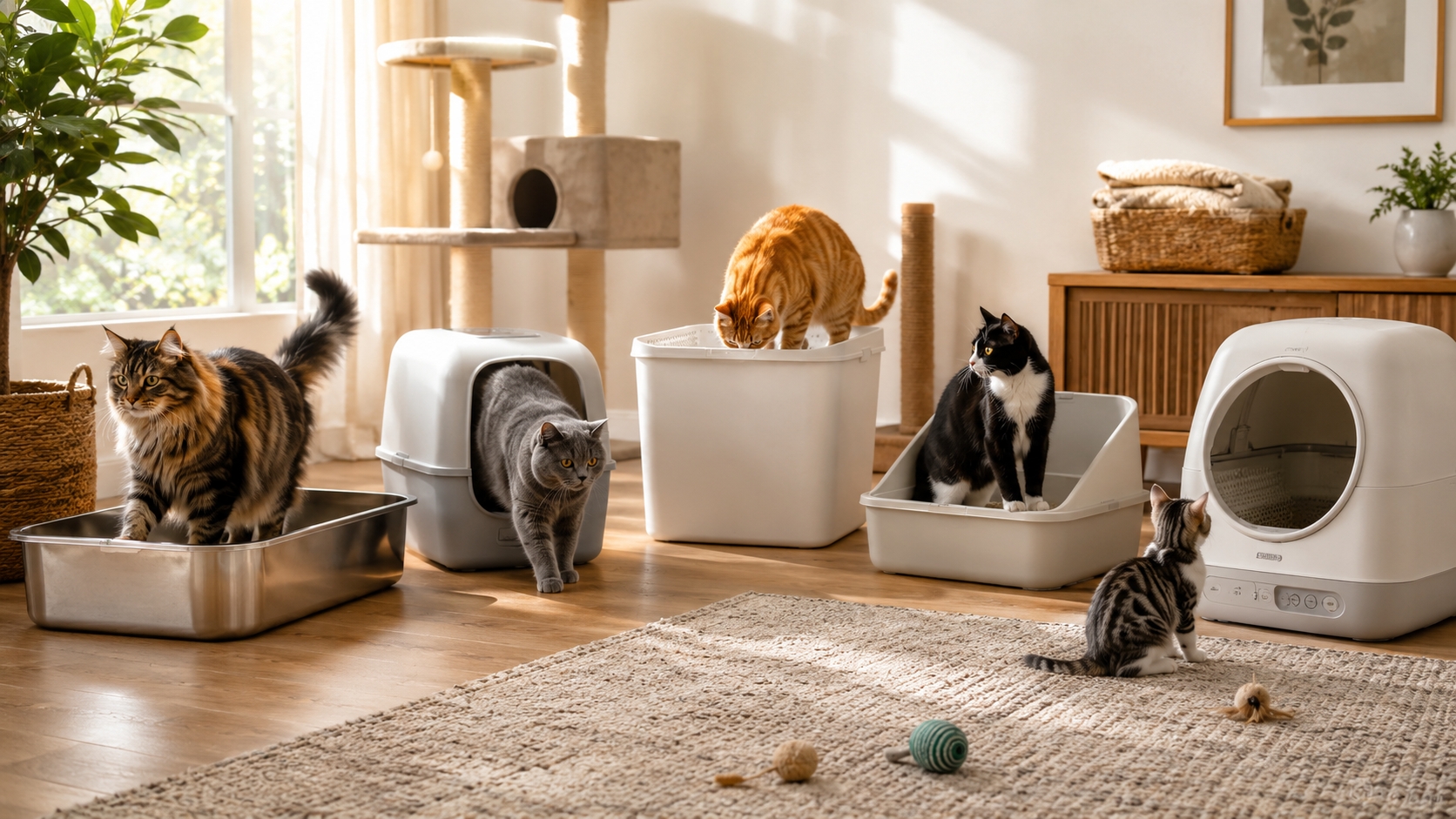
The Ultimate Cat Litter Box Guide
How to choose, place, fill, clean and troubleshoot the right litter box for every cat—from a tiny kitten to a dignified senior.
A litter box may not be the most glamorous purchase you make for your cat, but it is one of the most important. The right setup supports comfort, cleanliness, health and dependable bathroom habits. The wrong setup can create stress for your cat and frustration for everyone else.
Version 1.0: Prepared as the main hub for the Cats Central cat litter box library.
🐱 In a Hurry?
For most healthy adult cats, begin with the largest open litter box that fits your space, fill it with unscented litter your cat likes, scoop at least daily, place it somewhere quiet and accessible, and provide multiple boxes in a multi-cat home.
Those five steps prevent a remarkable number of litter box problems.
Why Your Cat’s Litter Box Matters
Cats are naturally clean animals. Their instinct to dig and cover waste is strong, but reliable litter box use depends on more than instinct. The box must feel safe, clean, roomy and easy to reach.
When a cat avoids the litter box, the cause is rarely spite. The cat may be uncomfortable, frightened, ill, unable to enter easily, unhappy with the litter, or intimidated by another pet. Looking at the situation from the cat’s point of view is the fastest route to a useful solution.
🩺 Veterinary Note
A sudden change in litter box habits deserves a veterinary examination—particularly when a cat strains, cries, urinates frequently in tiny amounts, repeatedly enters without producing urine, has blood in the urine, stops eating or seems unwell. Urinary blockage can become life-threatening, especially in male cats.
Find the Right Litter Box in Two Minutes
Kitten
Choose a roomy open box with a low entrance. Keep it nearby, easy to find and simple to enter. Use a kitten-appropriate litter and introduce changes gradually.
Healthy Adult
Begin with a large open box, unscented litter and daily scooping. Adapt only when your cat’s preferences or your household needs suggest a better option.
Senior Cat
Prioritize a low entrance, generous floor space, stable footing and a convenient box on every level your cat regularly uses.
Large Cat
Choose an extra-large rectangular box. Interior floor space matters more than the measurements printed on the package.
Enthusiastic Digger
A high-sided box and a generously sized litter mat usually reduce scatter without taking away visibility and ventilation.
Busy Household
An automatic box may reduce daily scooping, but it still needs inspection, waste removal, litter refills and regular cleaning.
The 10 Biggest Cat Litter Box Mistakes
- Buying a box that is too small. Your cat needs room to enter, sniff, turn, dig, eliminate, cover and leave without stepping in waste.
- Waiting until the box smells. Your cat’s nose noticed long before yours did. Scoop daily—twice daily when possible.
- Choosing litter for fragrance rather than feline comfort. Many cats prefer unscented, fine-textured litter.
- Hiding the box in a noisy or difficult location. Quiet and accessible beats invisible.
- Expecting one setup to last throughout life. A kitten grows; a senior cat may develop stiffness or arthritis.
- Forcing several cats to share too few resources. Multiple boxes reduce competition and provide choice.
- Changing the box, litter and location simultaneously. Change one thing at a time so you know what helps—or hurts.
- Assuming a cat is being naughty. Behaviour communicates discomfort, fear, pain or preference.
- Ignoring small warning signs. Hesitation, edge-perching or altered digging may appear before accidents.
- Thinking like a decorator instead of a cat. Comfort, safety and cleanliness matter more than matching the room.
⭐ The Three Rules
Buy bigger. Scoop daily. Listen to your cat.
Choosing the Right Size
Many store-bought litter boxes are designed to ship efficiently and fit neatly on retail shelves. That does not necessarily mean they provide enough usable room for an adult cat.
A practical starting point is a box at least one and a half times your cat’s body length, excluding the tail. Width must allow a complete turn without the cat pressing against every side.
| Cat | Useful Starting Point | Important Feature |
|---|---|---|
| Young kitten | 16–18 in / 40–46 cm long | Low, easy entrance |
| Average adult | 22–24 in / 56–61 cm long | Room to turn and dig |
| Large adult | 26–30 in / 66–76 cm long | Wide interior floor |
| Giant breed | 30+ in / 76+ cm long | Extra-large rectangular footprint |
Signs a box may be too small include a tail or rear end hanging over the edge, frequent urine outside the box, balancing on the rim, stepping in waste, reluctance to enter or a constant preference for one cramped corner.
🛒 Before You Buy
Check the interior dimensions. Thick rims, sloped walls, rounded corners and mechanical components can make a box feel much smaller than its outside measurements suggest.
Types of Cat Litter Boxes at a Glance
| Type | Best For | Watch For |
|---|---|---|
| Open | Visibility, ventilation, large cats, easy cleaning | Scatter and visible waste |
| Covered | Privacy and some mess containment | Trapped odor, limited room, one exit |
| High-sided | Diggers, high urinators, scatter control | Entrance height |
| Top-entry | Tracking control and discouraging dogs | Not ideal for mobility problems |
| Corner | Small spaces | Triangular interiors may feel cramped |
| Furniture-style | Discreet placement | Ventilation, access and cleaning space |
| Disposable | Travel, fostering, evacuation kits, short-term use | Replacement cost and waste |
| Automatic | Frequent waste removal and reduced scooping | Cost, maintenance, noise and cat acceptance |
Open vs. Covered Litter Boxes
Owners often choose covered boxes to hide waste and reduce visible mess. Cats evaluate the same box differently: Can I see what is approaching? Can I turn around? Is the odor concentrated? Can another cat block the only exit?
| Feature | Open | Covered |
|---|---|---|
| Ventilation | Excellent | More limited |
| Visibility and escape | Excellent | Usually one entrance |
| Scatter containment | Moderate | Good |
| Usable room | Often greater | Roof and walls reduce space |
| Ease of monitoring | Waste stays visible | Easy to forget until odor develops |
A large open box is a sensible starting point for many cats. A high-sided open box can contain much of the mess without trapping odor or removing visibility. Some cats genuinely prefer a covered design; whenever possible, offer both and let usage decide.
🐱 From the Cat’s Point of View
“I would rather have a plain, roomy box that is cleaned every day than a stylish enclosure that is cramped, smelly or easy for another pet to guard.”
Explore open litter boxes or compare them with covered litter boxes.
Plastic vs. Stainless Steel
Plastic is affordable, lightweight and available in almost every shape. Over time, however, digging can create scratches that retain residue and odor. Replace a plastic box when it becomes deeply scratched, cracked, stained or persistently smelly after washing.
Stainless steel costs more initially but resists scratches, staining and odor. Its smooth surface is easy to wash and can remain usable for years. The best material is still secondary to size, access and daily care.
| Feature | Plastic | Stainless Steel |
|---|---|---|
| Initial price | Lower | Higher |
| Weight | Light | Heavier |
| Style choices | Extensive | More limited |
| Scratch resistance | Lower | Excellent |
| Odor resistance over time | Variable | Excellent |
| Expected life | Replace as worn | Often many years |
Automatic Self-Cleaning Litter Boxes
Automatic litter boxes use weight or motion sensors, a delay and a raking, rotating or sifting mechanism to separate waste from clean litter. Their main advantage is a cleaner surface between visits—not freedom from all maintenance.
Potential Advantages
- Prompt waste removal and strong odor control
- Less routine scooping
- Consistent cleaning for busy households
- Potentially easier management for owners with mobility limitations
Potential Drawbacks
- Higher purchase and replacement-part costs
- Noise, movement and unfamiliar shapes
- Motors and sensors that need inspection
- Smaller usable interiors in some models
- Continued need for emptying, refilling and deep cleaning
⚠️ Introduce Gradually
Place the new unit beside the familiar box, leave it switched off at first, use familiar litter when permitted, and keep the old box available until your cat uses the new one confidently.
Choose a model with dependable sensors and a delayed cycle, follow the manufacturer’s size and weight requirements, and always keep a traditional backup available.
High-Sided, Top-Entry, Corner and Furniture-Style Boxes
High-Sided
Excellent for enthusiastic diggers and cats that urinate high. A lowered front entry preserves access for kittens and seniors.
Top-Entry
Can reduce tracking and discourage dogs, but requires climbing and is usually unsuitable for arthritic, injured or frail cats.
Corner
Uses awkward floor space efficiently. Check the interior footprint because triangular boxes can be surprisingly cramped.
Furniture-Style
Can blend with home décor while providing privacy. Insist on ventilation, adequate interior room, easy cleaning and safe access.
Hidden
Useful only when “hidden” does not also mean isolated, poorly ventilated or difficult for your cat to reach.
Disposable and Travel
Useful for short trips, fostering, emergencies and temporary recovery spaces.
The Right Box at Every Life Stage
Kittens
Use a low entrance, keep the box close to the kitten’s living area and provide several easy opportunities after waking, eating and playing. Never punish mistakes. Clean them thoroughly and quietly return to the routine.
How to train a kitten to use a litter box
Healthy Adults
Most adults thrive with a large, clean, stable box and consistent litter. Watch for changes rather than changing a successful setup merely because a new product appears.
Senior Cats
Older cats may need a lower entry, larger turning area, non-slip mat and more convenient placement. A box on every frequently used level can spare painful stairs and reduce accidents.
Best litter boxes for senior cats
Large and Giant Breeds
Maine Coons, Ragdolls, Norwegian Forest Cats, Siberians and large mixed-breed cats often outgrow standard trays. Choose the largest practical rectangular interior and observe the entire toileting sequence—not merely whether the cat can stand inside.
Multi-Cat Homes
Cats that sleep together may still prefer separate bathroom resources. Competition can be subtle: a stare, a cat resting near a doorway or an ambush after another cat exits may be enough to discourage use.
- Distribute boxes in separate areas rather than lining them all up in one room.
- Provide more than one route in and out whenever possible.
- Keep every box large, clean and genuinely usable.
- Watch interactions around boxes, not only direct fights.
- Add a box before a conflict becomes a habit.
Where Should You Put the Litter Box?
The ideal location is quiet but not isolated, easy to reach at all times, separated from food and water, free from sudden appliance noise and arranged so another pet cannot block the exit.
| Good Choice | Why It Works | Possible Problem |
|---|---|---|
| Quiet bathroom | Easy cleaning and regular access | Closed door or cramped floor plan |
| Spare room or office | Low traffic and predictable | Access restricted during meetings or guests |
| Laundry room | Practical flooring | Washer, dryer or furnace noise |
| Dedicated cat area | Stable and familiar | Do not place food directly beside the box |
| Basement | Private and spacious | Stairs, darkness, cold or distance |
In a multi-level home, place at least one box on every level your cat regularly uses—especially for kittens, seniors and cats with mobility limitations.
How Many Litter Boxes Do Cats Need?
The familiar recommendation—one box per cat, plus one extra—is a useful starting point, not an inflexible law. The real goals are choice, cleanliness, convenient access and freedom from competition.
| Cats | Starting Number | Placement |
|---|---|---|
| 1 | 2 when space allows | Two useful locations |
| 2 | 3 | Spread through the home |
| 3 | 4 | Avoid one guarded “bathroom room” |
| 4 | 5 | Include multiple floors where applicable |
Three boxes placed side by side may feel like one resource to a cat. Separating them gives genuine alternatives.
Choosing the Best Cat Litter
Many cats prefer a soft, fine texture and little or no added fragrance. Individual preferences, health needs and early experiences still matter, so a litter that works beautifully for one cat may be rejected by another.
| Type | Strengths | Considerations |
|---|---|---|
| Clumping clay | Easy scooping, familiar texture, strong odor control | Weight, dust and tracking vary |
| Non-clumping clay | Affordable and widely available | More frequent complete changes |
| Silica crystal | Lightweight and low dust | Hard texture or sound may bother some cats |
| Pine | Renewable, low dust, natural scent | Pellet texture can require transition |
| Paper | Soft, low dust, useful after some surgeries | Usually weaker clumping and odor control |
| Corn or walnut | Plant-based alternatives with useful absorption | Performance, dust and cat acceptance vary by brand |
Changing Litter Gradually
Unless your veterinarian recommends an immediate change, mix increasing amounts of the new litter into the familiar litter over several weeks. Changing one variable at a time makes your cat’s response easier to understand.
🐾 Cats Central Tip
The best-smelling litter to a person is not necessarily the best litter for a cat. Clean should smell like almost nothing—not perfume.
Cleaning, Maintenance and Odor Control
| Task | Useful Routine |
|---|---|
| Scoop | At least daily; morning and evening when possible |
| Top up litter | As needed to maintain the manufacturer’s recommended depth |
| Wipe exterior and surrounding floor | Weekly or whenever soiled |
| Completely change litter | According to litter type, use and condition |
| Wash box | Every few weeks or as needed |
| Inspect plastic | Every few months for scratches, cracks and retained odor |
How to Wash the Box
- Empty all litter.
- Wash with warm water and mild, unscented soap.
- Rinse thoroughly so no fragrance or residue remains.
- Dry completely before adding fresh litter.
- Wash the scoop and mat as well.
Avoid relying on air fresheners to disguise waste. Daily scooping, good ventilation, complete litter changes and replacement of worn plastic boxes control odor more effectively.
Common Litter Box Problems and Solutions
| What You Notice | What to Check | Useful First Step |
|---|---|---|
| Urine outside the box | Medical problems, cleanliness, size, litter, location, conflict | Veterinary examination, then environmental review |
| Stool outside the box | Constipation, pain, box size, aversion, too few boxes | Check health and provide a larger clean box |
| Perching on the rim | Cramped interior or disliked surface | Offer a substantially larger box |
| Urine over the edge | Low sides, small box, standing urination | Large high-sided box with suitable entry |
| Litter everywhere | Normal digging, small box, light litter | High sides and a large mat |
| One cat avoids the room | Resource guarding or ambush | Add boxes in different locations |
| Refusal after a change | New box, litter, scent or location | Restore the familiar option and transition gradually |
Never Punish Litter Box Accidents
Punishment increases stress and does not identify the cause. Clean the area with a product intended to remove pet odor, protect the spot temporarily and investigate health, comfort, access and household changes.
The Ultimate Litter Box Buyer’s Checklist
📏 Size
- At least 1½ times body length
- Comfortable turning space
- Enough room for digging and covering
- Large enough for a growing kitten
🚪 Entry
- Easy for this cat’s age and mobility
- Low entry for kittens and seniors
- Stable, non-slip approach
🐱 Comfort
- Good ventilation
- No cramped roof or doorway
- Clear exit
- Quiet, predictable setting
🧹 Cleaning
- Easy to scoop
- Easy to lift and wash
- No unreachable corners
- Replacement parts readily available
🏡 Placement
- Fits a genuinely useful location
- Away from food and water
- Accessible at all times
- Cannot be easily guarded
💰 Value
- Meets the cat’s needs first
- Durable enough for expected use
- Ongoing costs fit the household
- Still likely to suit the cat next year
See the Litter Box Through Your Cat’s Eyes
| You Notice | Your Cat Notices |
|---|---|
| It fits neatly in a corner. | Can I turn around? |
| The cover hides the mess. | Can I see and leave safely? |
| It smells like lavender. | Why is my bathroom full of perfume? |
| It is beside the washing machine. | Why does the room suddenly roar and shake? |
| It is compact and stylish. | My whiskers, back and tail touch everything. |
| It looks clean enough. | I can still smell yesterday. |
Whenever a choice is unclear, ask: Does this make the bathroom safer, cleaner or more comfortable for my cat—or merely less visible to me?
The Five-Minute Litter Box Health Check
Your Cat
- Enters confidently
- Turns comfortably
- Does not balance on the rim
- Shows no pain, straining or hesitation
The Box
- Still large enough
- Easy entrance
- No deep scratches, cracks or retained odor
- Stable on the floor
The Litter
- Acceptable texture and scent
- Appropriate depth
- Not excessively dusty
- Changed gradually when needed
The Location
- Quiet and reachable
- No blocked route
- Away from food
- No new appliance or household disturbance
Your Routine
- Daily scooping
- Regular full changes
- Periodic washing
- Observation of urine and stool changes
The best score is not a number. It is a cat that approaches, uses and leaves the box without hesitation.
Cat Litter Box Cheat Sheet
| Buy | Place | Clean | Watch |
|---|---|---|---|
| Largest practical box Low entry when needed Unscented litter to start Sturdy scoop and mat | Quiet Accessible Away from food Multiple locations for multiple cats | Scoop daily Top up as needed Wash regularly Replace worn plastic | Hesitation Edge-perching Urine or stool outside Sudden changes Straining or pain |
The Golden Rule
When you are unsure what to do, ask whether the change will make your cat’s bathroom cleaner, safer or more comfortable. If the answer is yes, you are probably moving in the right direction.
Frequently Asked Questions
How often should I scoop a cat litter box?
Scoop at least once every day. Twice daily is even better, especially in multi-cat homes. Prompt removal of waste controls odor, keeps the box inviting, and helps you notice changes in urine or stool.
How many litter boxes should I have?
A useful starting point is one litter box per cat, plus one extra, placed in different areas of the home. Some cats manage with fewer, but choice and access matter more than a rigid formula.
What size should a cat litter box be?
Choose a box at least one and a half times your cat's body length, excluding the tail, with enough width for comfortable turning, digging, eliminating, covering, and exiting.
Are covered litter boxes better than open litter boxes?
Not automatically. Covered boxes can contain scatter and hide waste, but open boxes offer better ventilation, visibility, and escape options. Your cat's preference should decide.
Is stainless steel better than plastic?
Stainless steel resists scratches, odors, and staining and can last for years. Plastic is lighter, less expensive, and available in more styles, but should be replaced when scratched, cracked, or persistently odorous.
What litter is best for most cats?
Many cats accept a fine-textured, unscented clumping litter. Individual preferences vary, so avoid abrupt changes and transition gradually.
Where should I put the litter box?
Choose a quiet, easy-to-reach location away from food, water, noisy appliances, and places where another pet could block access.
Why is my cat suddenly not using the litter box?
A sudden change can signal pain, urinary disease, constipation, stress, conflict, a dirty box, disliked litter, or poor access. Arrange a veterinary examination first, especially when the change is abrupt.
Are automatic litter boxes safe?
Well-designed units use sensors and delayed cleaning cycles, but they still require supervision during introduction, regular inspection, and a traditional backup box.
When is litter box trouble an emergency?
Repeated straining, frequent attempts with little or no urine, crying, blood in the urine, vomiting, weakness, or sudden collapse require urgent veterinary attention. Urinary blockage can be life-threatening, particularly in male cats.
Continue Exploring the Cats Central Litter Box Library
Use the hub as your starting point, then open the detailed guide that matches your cat, home or immediate problem.
Best Litter Boxes for Kittens
Best Litter Boxes for Senior Cats
Best Litter Boxes for Large Cats
Best Litter Boxes for Multiple Cats
Best Litter Boxes for Small Apartments
Automatic Self-Cleaning Litter Boxes
Open Cat Litter Boxes
Covered Cat Litter Boxes
High-Sided Cat Litter Boxes
Top-Entry Cat Litter Boxes
Corner Cat Litter Boxes
Stainless Steel Cat Litter Boxes
Extra-Large Cat Litter Boxes
Furniture-Style Cat Litter Boxes
Hidden Cat Litter Boxes
Disposable Cat Litter Boxes
Travel Cat Litter Boxes
How Many Litter Boxes Do Cats Need?
Where Should You Put a Litter Box?
How to Clean a Litter Box
How Often Should You Clean a Litter Box?
How to Stop Litter Box Smells
Litter Box Odor Control
Cat Litter Box Mats
Cat Litter Box Liners
Litter Box Accessories
Why Is My Cat Not Using the Litter Box?