
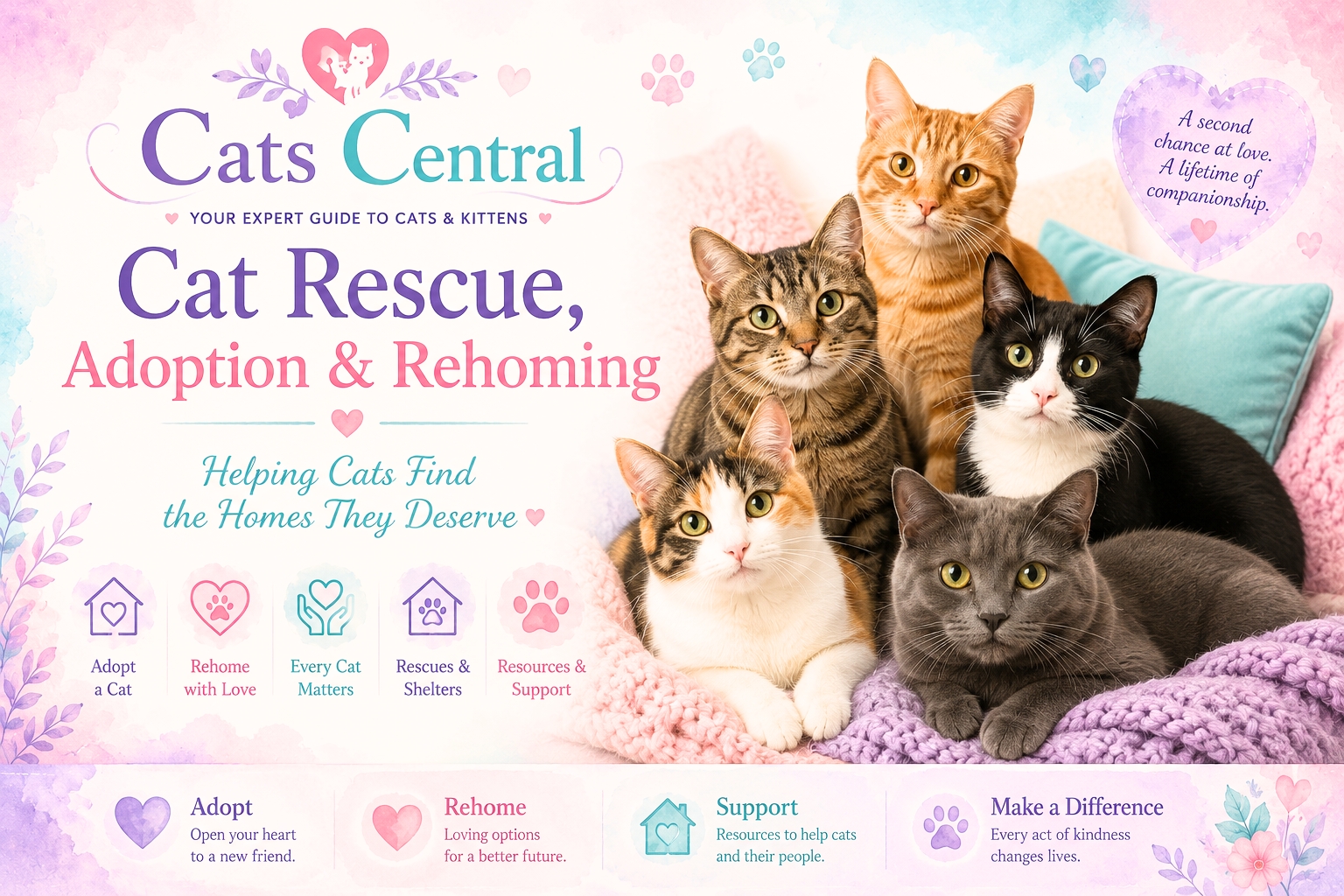
 Cats come into rescue, adoption and rehoming situations for all kinds of reasons. Some are lost or found outdoors. Some need new homes after a family moves, becomes ill, loses housing, faces financial hardship or discovers that a particular household simply is not the right fit. Others are kittens born outdoors, senior cats whose owners can no longer care for them, or community cats who need humane population management rather than a conventional indoor home.
Whatever brought you here, the most useful question is not simply, “Where can I find a cat?” or “Where can I take my cat?” It is: what is the safest, most appropriate next step for this individual cat?
This Cats Central hub is designed to help you answer that question. Start with the pathway that best describes your situation, then use the deeper guides throughout this section when you need more detail.
Choose the Help You Need
🐾 I Want to Adopt a Cat
Learn how to choose a cat who fits your household, understand adoption fees, prepare your home, ask the right questions and help your new companion settle in.
🏡 I Need to Rehome My Cat
Explore responsible rehoming, adopter screening, veterinary preparation, honest adoption profiles, shelter alternatives and ways to reduce the risk of a failed placement.
❤️ I Found a Cat or Kittens
Figure out whether the cat may be lost, stray, feral or part of a managed community-cat population, and learn when kittens or injured cats need immediate help.
Cats Central principle:The goal is not to move a cat from one place to another as quickly as possible. The goal is to create the safest and most lasting outcome available for that cat.
I Want to Adopt a Cat
Adopting a cat can be wonderfully rewarding, but the best adoption begins before you meet the cat who makes you forget every sensible question you meant to ask.
A successful match depends on more than color, breed, age or the emotional pull of a photograph. Consider your household, schedule, budget, other animals, children, housing rules and the amount of grooming, play, veterinary care and companionship you can realistically provide.
Before You Adopt, Ask Yourself
- Are all household members comfortable bringing home a cat?
- Does your lease, condominium or housing situation permit cats?
- Can you afford routine veterinary care as well as unexpected illness or injury?
- Do you have time for daily feeding, litter-box care, play, grooming and companionship?
- Do you already have cats, dogs or other animals?
- Would a kitten, adult or senior cat best fit your lifestyle?
- Are you prepared to help a shy cat adjust without forcing interaction?
- Who will care for the cat during travel, hospitalization or emergencies?
If you are just beginning, visit How to Adopt a Cat for a step-by-step guide.
Adoption is a match, not a rescue fantasy.The right cat is not necessarily the cat who appears to need you the most. A good adoption respects the needs of both the cat and the household so that the placement has the best chance of lasting.
Where to Adopt a Cat
Cats may be available through many legitimate channels. The best choice depends on your location and the type of cat you hope to adopt.
Municipal Shelters
City or county shelters may care for strays, surrendered pets and animals involved in animal-control cases. Policies, adoption procedures and available history vary widely.
Humane Societies & SPCAs
Independent humane organizations may operate shelters, foster programs, veterinary services, community programs and adoption centers.
Foster-Based Rescues
Cats living in foster homes may come with especially useful information about personality, household behavior, dogs, other cats, children and daily routines.
Breed-Specific Rescue
Breed rescues sometimes place pedigreed cats, documented purebreds, mixes and cats whose appearance resembles a particular breed.
Private Rehoming
Owner-to-owner adoption can work well when the cat’s history is known and the placement is handled carefully, honestly and with reasonable screening.
Veterinary & Community Networks
Veterinary clinics, local welfare groups and community organizations may sometimes know of cats needing homes or reputable rescue partners.
Questions to Ask Before Adopting
- What is known about the cat’s history?
- Has the cat lived successfully with other cats, dogs or children?
- Has the cat had a veterinary examination?
- Is the cat spayed or neutered?
- What vaccinations or parasite treatments are documented?
- Is the cat microchipped?
- Are there known medical, dietary, grooming or litter-box needs?
- How does the cat respond to handling?
- What kind of home does the rescue, foster caregiver or owner believe would suit the cat best?
- What happens if the placement proves unsuitable?
You can also explore Cats for Adoption on Cats Central.
Choosing the Right Cat for Your Household
The cat who looks perfect in a photograph is not automatically the cat who will be happiest in your home. Temperament, activity level, social history and care needs matter enormously.
Kitten, Adult or Senior?
Kittens are playful, curious and still developing. They need frequent interaction, safe socialization, veterinary care and plenty of appropriate outlets for climbing, scratching and play.
Young adults may still be extremely energetic, but their personalities are often more apparent than those of very young kittens.
Mature adults can be excellent companions for people who want a more established personality and a clearer idea of activity level, grooming needs and social preferences.
Senior cats are often overlooked. Many are wonderfully affectionate companions, especially for quieter households, but adopters should plan carefully for age-related veterinary care.
Think About Temperament
Some cats march into a new room as if they’ve been paying the mortgage for years. Others need time, quiet and predictable routines before they feel safe.
Ask the people who know the cat whether the cat is:
- Social or reserved with strangers
- Highly playful or relatively calm
- Comfortable being picked up
- Talkative or quiet
- Comfortable around other cats
- Known to tolerate dogs
- Comfortable with children
- Likely to need significant grooming
- Prone to hiding during change or stress
Breed can provide useful background, but individual personality should carry more weight than stereotypes. Explore our Cat Breeds & Types library if you want to compare likely breed traits before adopting.
How Much Does Cat Adoption Cost?
Adoption costs vary enormously by organization, region, age, medical history and what care has already been provided. A posted adoption fee also tells you only part of the financial story.
A shelter or rescue fee may include some combination of:
- Spay or neuter surgery
- Vaccinations
- Microchipping
- Parasite treatment
- Veterinary examination
- Testing performed according to the organization’s protocol
- Temporary foster care
- Food, litter and daily care while awaiting adoption
Budget Beyond the Adoption Fee
Your first weeks with a cat may also involve:
- A secure carrier
- Food and water dishes
- Appropriate food
- Litter and litter boxes
- Scratching surfaces
- Beds, hiding options and climbing/perching space
- Toys and enrichment
- Grooming equipment
- An initial veterinary visit
- Prescription diets or medication when needed
- Emergency-care savings or pet insurance, if appropriate for your situation
See for details on Cat Adoption Costs: Fees, First-Year Expenses & What to Budget.
Price is not a quality score.A low or waived adoption fee does not make a cat less valuable, and a high fee does not guarantee responsible care. Evaluate the organization, veterinary information, transparency and suitability of the match.
Preparing Your Home for an Adopted Cat
A new cat does not need immediate access to every room in the house. In many cases, starting with a quiet, comfortable home base makes the transition easier.
Create a Safe Room or Quiet Home Base
Prepare a room with:
- Food and fresh water
- A litter box positioned away from food and water
- A comfortable bed or blanket
- A secure hiding place
- A scratching surface
- Safe toys
- An elevated resting place when possible
Cat-Proof Before Arrival
- Check windows and screens.
- Secure exterior doors.
- Remove toxic plants and unsafe household chemicals.
- Store thread, ribbon, string and small swallowable objects safely.
- Protect electrical cords where necessary.
- Check washers, dryers, reclining chairs and other enclosed spaces before use.
See Preparing Your Home for a Cat for a deeper checklist.
Helping an Adopted Cat Settle In
Some cats stroll out of the carrier and begin inspecting the premises. Others disappear beneath the nearest bed and conduct all diplomatic negotiations from there.
Both responses can be normal.
Give your new cat time to learn the household at a manageable pace. Keep routines predictable, avoid unnecessary visitors during the first adjustment period and allow the cat to initiate contact when possible.
During the First Days
- Keep food familiar unless there is a reason to change it.
- Maintain a consistent feeding schedule.
- Keep the litter box clean and easy to find.
- Provide hiding places rather than forcing the cat into the open.
- Introduce additional rooms gradually.
- Watch appetite, water intake, urine and stool.
- Arrange veterinary follow-up if needed.
Read Helping an Adopted Cat Settle In.
Call a veterinarian when something seems medically wrong.Difficulty breathing, repeated vomiting, severe lethargy, inability to urinate, collapse, serious injury or a cat who appears acutely ill should not be dismissed as ordinary adoption stress.
Introducing an Adopted Cat to Other Cats or Dogs
A new cat should not usually be carried into the living room and introduced nose-to-nose to the resident animals on arrival.
Introducing Cats
A gradual introduction may include:
- Separate living areas at first.
- Scent exchange through bedding or room rotation.
- Positive experiences on opposite sides of a closed door.
- Controlled visual access.
- Short supervised meetings.
- Gradually increased shared time if both cats remain relaxed.
If tension develops, see our Cat-on-Cat Aggression guide.
Introducing Cats and Dogs
Keep the dog under control and prevent chasing. The cat should have high escape routes, dog-free areas and the ability to retreat without being pursued.
Do not measure success by how quickly the animals are touching. Calm coexistence is a far more important goal.
Senior Cats, Bonded Pairs & Special Adoption Situations
Adopting a Senior Cat
Senior cats can be exceptional companions. Their personalities are usually well established, and many settle beautifully into quieter homes.
Ask about mobility, dental health, weight changes, kidney function, thyroid health, vision, hearing, current medication and recommended follow-up care.
Planned supporting guide: Senior Cat Adoption & Rescue.
Adopting a Bonded Pair
Some cats form close social relationships and are best placed together. Ask why the pair is considered bonded and how they behave when separated.
Two cats mean additional veterinary, food and litter costs, but a compatible pair may provide one another with familiarity and companionship during a major transition.
Adopting a Shy Cat
A shy cat may be a wonderful companion for an adopter who is comfortable allowing trust to develop gradually. Progress may look like eating while you are present, emerging from hiding sooner, playing, or choosing to sit nearby before physical affection begins.
Adopting a Cat With Medical Needs
Ask for the actual diagnosis, veterinary records, treatment plan, medication schedule, likely ongoing costs and whether specialty care may be needed.
Do not assume “special needs” means poor quality of life. Equally, do not adopt a medically complex cat without understanding the practical and financial commitment.
Purebred & Breed-Specific Cat Adoption
Purebred and breed-type cats do enter shelters, rescues and private rehoming. They may be surrendered because of family circumstances, breeder retirement, owner illness, incompatibility with other pets, grooming needs, medical issues or simply because the original home did not work out.
Breed rescue can be a particularly good option for people who appreciate certain breed tendencies but are open to an adult rather than insisting on a kitten.
Be Realistic About Breed Labels
A shelter label such as “Siamese,” “Maine Coon,” “Russian Blue” or “Bengal mix” may be an informed estimate based on appearance and behavior. Unless there is reliable pedigree or registration history, appearance alone cannot prove ancestry.
Breed-Specific Adoption Pages
As the Cats Central adoption library grows, we will develop dedicated rescue/adoption resources for breeds with meaningful search demand, including rare breeds that may be difficult to find.
Examples planned for deeper coverage include:
- Ragamuffin adoption and rescue
- Birman adoption and rescue
- Abyssinian adoption and rescue
- Turkish Angora adoption and rescue
- Exotic Shorthair adoption and rescue
- Singapura adoption and rescue
- Selkirk Rex adoption and rescue
Start with our Cat Breeds & Types guide to learn what living with a particular breed may actually involve.
I Need to Rehome My Cat
Needing to rehome a cat can be painful, but circumstances change. Housing, health, finances, family responsibilities, allergies, conflict between pets and other serious situations can make keeping a cat impossible or unsafe.
Responsible rehoming means treating the cat as an individual, preparing carefully and looking for a home that can realistically meet that cat’s needs.
First, Ask Whether the Problem Can Be Solved
Depending on the situation, useful alternatives might include:
- Veterinary treatment for a medical problem affecting behavior
- Behavior assistance
- Temporary foster care with trusted family, friends or a rescue organization
- Pet-food assistance
- Low-cost veterinary programs
- Help locating pet-friendly housing
- Short-term pet sitting or boarding
- Environmental changes in a multi-cat household
If rehoming remains necessary, move forward without guilt and concentrate on doing it well.
Prepare the Cat for Adoption
- Gather veterinary records.
- Update microchip information.
- Arrange a veterinary examination when practical.
- Provide accurate information about spay/neuter status and vaccines.
- Write down medications, diet and routines.
- Describe litter-box habits honestly.
- Disclose bite, scratch, fear or compatibility history rather than hiding it.
- Take recent, clear photographs.
Screen Potential Adopters
Ask reasonable questions about:
- Who lives in the home
- Other pets
- Previous cat experience
- Housing and landlord permission where relevant
- Indoor/outdoor plans
- Veterinary care
- What they want in a cat
- How they would handle a future move or major life change
Visit Cat Rehoming for the current Cats Central rehoming section.
Honesty protects the cat.A description designed to “sell” a cat by hiding medical or behavior concerns may get faster inquiries, but it increases the risk of a failed adoption and another stressful move.
Cat Shelters, Rescues & Surrender Options
If you cannot rehome the cat directly, contact local shelters and rescue groups early rather than waiting until the final day before a move or crisis.
Organizations may have different:
- Service areas
- Intake requirements
- Appointment systems
- Waiting lists
- Surrender fees
- Medical requirements
- Capacity for behavior or special-needs cases
Do not assume that every private rescue accepts owner surrenders or that every shelter can take a cat immediately.
Information to Have Ready
- Your general location
- The cat’s age and sex
- Spay/neuter status
- Medical and vaccination history
- Medication and dietary needs
- Temperament
- Compatibility with cats, dogs and children
- Any bite or serious behavior history
- Reason rehoming is needed
- The time frame available
Planned supporting guide: Cat Rehoming Services, Shelters & Other Options.
I Found a Cat: What Should I Do?
Do not assume that every outdoor cat is homeless.
The cat may be:
- An owned indoor-outdoor cat
- A lost pet
- A recently abandoned socialized cat
- A long-term stray
- An unsocialized community cat
If the Cat Appears Friendly and Can Be Handled Safely
- Check whether neighbors recognize the cat.
- Look through local lost-pet listings.
- Arrange a microchip scan through a veterinarian, shelter or other local service where available.
- Report the found cat according to local requirements.
- Keep the cat separated from your own pets until health status is better understood.
If the cat appears injured, extremely ill, weak or unable to move normally, contact a veterinarian, animal-control service or experienced rescue for guidance.
Planned supporting guide: I Found a Cat: Lost, Stray or Feral?
Stray Cats, Feral Cats & Community Cat Rescue
Stray and feral cats are often lumped together, but the distinction can change what help is most appropriate.
What Is a Stray Cat?
A stray cat is generally a cat who has been socialized to people at some point but is currently living outdoors without an obvious home. Some strays are lost pets; others may have been abandoned or have drifted between homes and outdoor life.
What Is a Feral or Unsocialized Community Cat?
A feral or unsocialized community cat may have had little positive human contact and may not be comfortable living in a conventional home. Some live independently; others live around regular caregivers or in managed colonies.
What Is TNR?
Trap-Neuter-Return, commonly called TNR, involves humanely trapping community cats, having them spayed or neutered and usually vaccinated according to the program’s protocol, allowing appropriate recovery and returning suitable cats to their established outdoor territory.
Friendly adults and kittens may sometimes be candidates for foster care and adoption rather than return, depending on age, socialization, health, local resources and experienced assessment.
Local rules matter.Community-cat, trapping, feeding, shelter-intake and TNR rules differ among cities and regions. Work with experienced local organizations rather than relying on a universal internet rule.
Major Cats Central Community-Cat Guides We Plan to Build
- Feral Cat Rescue
- Stray Cat Rescue
- Feral vs Stray Cats
- Trap-Neuter-Return (TNR)
- Community Cat Care
- Outdoor Cat Shelters
- Winter Care for Community Cats
- Finding TNR and Feral Cat Rescue Near You
I Found Kittens Outdoors: Should I Rescue Them?
Finding tiny kittens outdoors triggers every human instinct that says, “Pick them up!” Sometimes that is exactly what is needed. Sometimes the mother cat is nearby and returning to care for them.
When the kittens are not in immediate danger, observe from a distance and consider:
- Are they warm, clean and relatively quiet?
- Do their bellies appear reasonably full?
- Is the nest in a protected location?
- Could the mother simply be away finding food?
Act More Quickly When
- Kittens are cold
- Kittens are injured or bleeding
- They are crying continuously and appear distressed
- They are weak or unresponsive
- They are in immediate danger from traffic, weather or predators
- The mother is known to be dead or unable to return
Very young kittens can deteriorate quickly and have specialized warmth and feeding needs. Seek veterinary or experienced kitten-rescue guidance rather than improvising care for a compromised neonatal kitten.
Planned supporting guide: Found Kittens Outdoors: When to Wait for Mom and When to Help.
When a Cat Needs Urgent Help
Rescue and adoption questions sometimes become medical or public-safety emergencies.
Seek prompt veterinary or appropriate emergency assistance when a cat has:
- Difficulty breathing
- Severe bleeding or obvious serious trauma
- Collapse or extreme weakness
- Possible poisoning
- Repeated vomiting with marked illness
- Inability to urinate
- Seizures
- Severe pain
- Very young kitten status combined with coldness, weakness or failure to feed
Do not attempt to pick up a terrified or aggressive unknown cat with bare hands. A frightened cat may bite or scratch defensively, especially when injured.
For cruelty, abandonment, dangerous-animal or immediate public-safety concerns, contact the appropriate local animal-control, humane or law-enforcement authority.
Fostering Cats & Other Ways to Support Rescue
You do not need to adopt permanently to make a meaningful difference.
Fostering
Foster caregivers provide temporary homes for cats who may be:
- Too young for adoption
- Recovering from illness or surgery
- Pregnant or nursing
- Shy and in need of home-based observation
- Waiting for permanent adoption
- Displaced by an emergency
Before fostering, ask the organization who pays for veterinary care, supplies and medication, how emergencies are handled and what happens if the placement is not workable.
See Fostering Cats.
Other Ways to Help
- Volunteer with a reputable rescue or shelter.
- Transport cats to veterinary appointments or foster homes.
- Donate food, litter or funds where needed.
- Photograph adoptable cats.
- Help write accurate adoption profiles.
- Support spay/neuter and TNR programs.
- Share legitimate adoption listings responsibly.
- Offer administrative, fundraising or technical skills.
Frequently Asked Questions About Cat Rescue, Adoption & Rehoming
Where can I adopt a cat near me?
Check municipal animal shelters, humane societies, foster-based rescues, breed-specific rescues and reputable owner-to-owner rehoming programs in your area. Verify current adoption procedures before visiting because hours, applications and appointment requirements can change.
How much does it cost to adopt a cat?
Adoption fees vary by region, organization, age and the veterinary care already provided. Budget for supplies and ongoing veterinary care in addition to the adoption fee.
Is it better to adopt a kitten or an adult cat?
Neither is automatically better. Kittens usually need more supervision, play and developmental care. Adult cats often have more established personalities, which can make matching easier.
Can I adopt a purebred cat from a rescue?
Yes. Pedigreed and breed-type cats do enter rescue and private rehoming. However, breed identification may be uncertain when documentation is unavailable.
How do I safely rehome my cat?
Gather veterinary records, create an honest description, screen prospective adopters, disclose medical and behavior history, plan the transition carefully and consider a written agreement or assistance from a reputable rescue or rehoming service.
Where can I surrender a cat?
Contact local municipal shelters, humane organizations and rescues to ask about current intake policies. Many organizations require appointments or maintain waiting lists, so reach out as early as possible.
What is the difference between a stray cat and a feral cat?
A stray cat has generally been socialized to people and may be lost or abandoned. A feral or unsocialized community cat may have limited comfort with human contact and may be better suited to a humane community-cat program rather than immediate indoor adoption.
What should I do if I find a friendly cat outside?
Consider that the cat may be lost. Check with neighbors, look at local lost-pet listings, arrange a microchip scan when safe and follow local found-animal requirements.
What should I do if I find kittens outside?
If they are safe, warm and appear cared for, observe from a distance to see whether the mother returns. If kittens are cold, injured, weak, continuously distressed or in immediate danger, seek veterinary or experienced rescue help promptly.
Should I let a newly adopted cat meet my resident cat immediately?
Usually not. Gradual introductions using separation, scent exchange, controlled visual contact and short supervised meetings reduce the risk of fear and conflict.
How long does an adopted cat take to settle in?
Some cats adjust within days; others need weeks or longer. Personality, history, health, environment and the pace of introductions all matter.
Is charging a rehoming fee enough to keep a cat safe?
No. A fee may discourage some impulsive inquiries, but thoughtful adopter screening and honest matching are much more important.
Trusted Cat Rescue, Adoption & Community-Cat Resources
- ASPCA — Adoption Tips — Preparing for adoption and bringing a new pet home.
- Humane World for Animals — Finding a New Home for Your Pet — General guidance for people who need to rehome a companion animal.
- Alley Cat Allies — Feral and Stray Cats: An Important Difference — Understanding socialization and community-cat situations.
- Alley Cat Allies — Guide to Trap-Neuter-Return — Practical TNR information.
- Alley Cat Allies — What to Do if You Find Kittens Outdoors — Age- and circumstance-based kitten guidance.
- ASPCA — Position Statement on Community Cats — Community-cat welfare and pathway considerations.
Veterinary and local-resource note: Cats Central provides general educational information. Veterinary emergencies require professional care, and shelter, animal-control, ownership, trapping and TNR rules vary by location.
Our Commitment to Cats
Cats Central supports responsible adoption, compassionate rescue, humane community-cat programs and safe rehoming when circumstances make a new home necessary.
We want adopters to find cats who truly fit their households. We want people who must rehome a beloved cat to have practical guidance rather than judgment. We want lost cats to have a reasonable chance of getting home, community cats to receive humane care, and kittens to receive the right help at the right time.
The best outcome is not always the fastest outcome. It is the one most likely to protect the cat’s health, emotional wellbeing and long-term security.
Last reviewed: August 15, 2026