
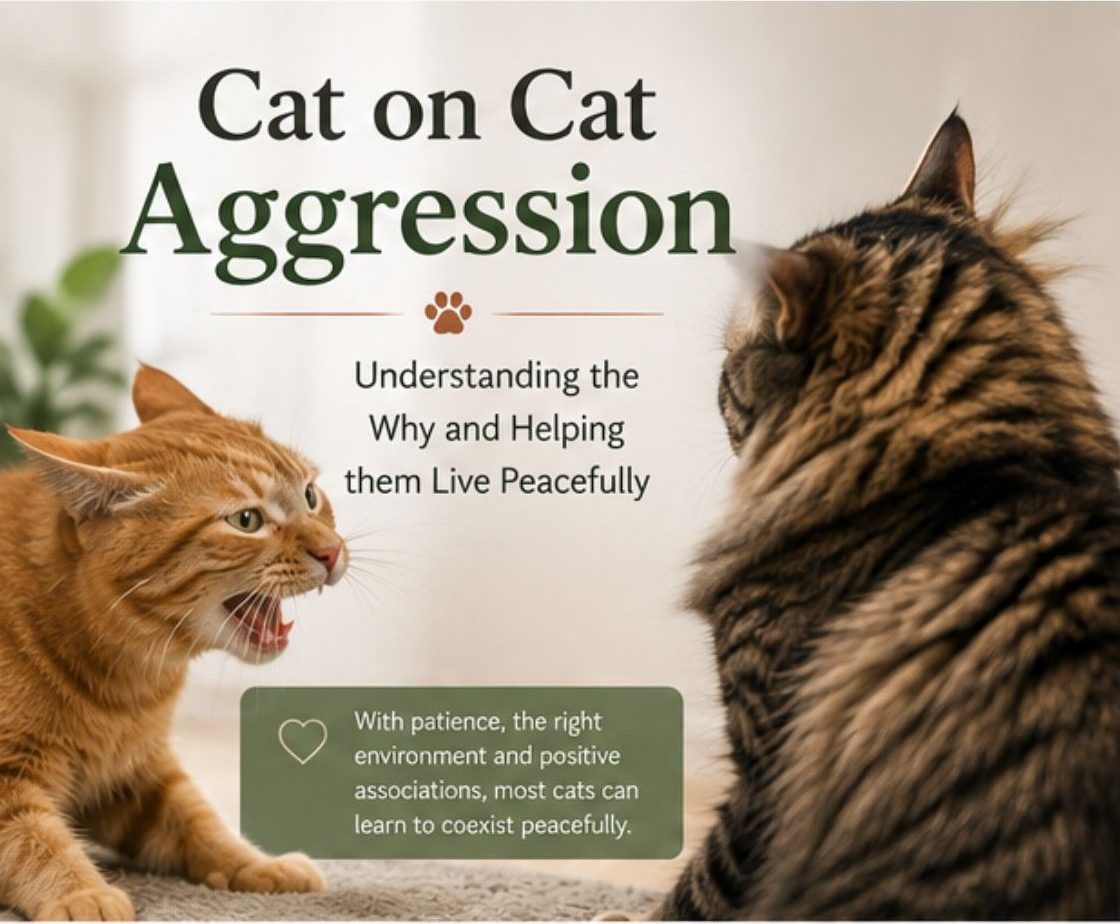
Cat-on-cat aggression can turn a peaceful home upside down. Two cats that once slept together may suddenly hiss across the room. A newly adopted cat may stalk a resident cat. One cat may block another from food, litter boxes, or favorite resting places. Sometimes the conflict is obvious; other times, the tension is quiet and easy to miss.
The most important thing to understand is that cats do not need to be physically fighting for a relationship to be stressful. The 2024 AAFP Intercat Tension Guidelines emphasize that tension between household cats can include subtle behaviors such as staring, blocking access, chasing, avoiding, hiding, or changing normal routines.
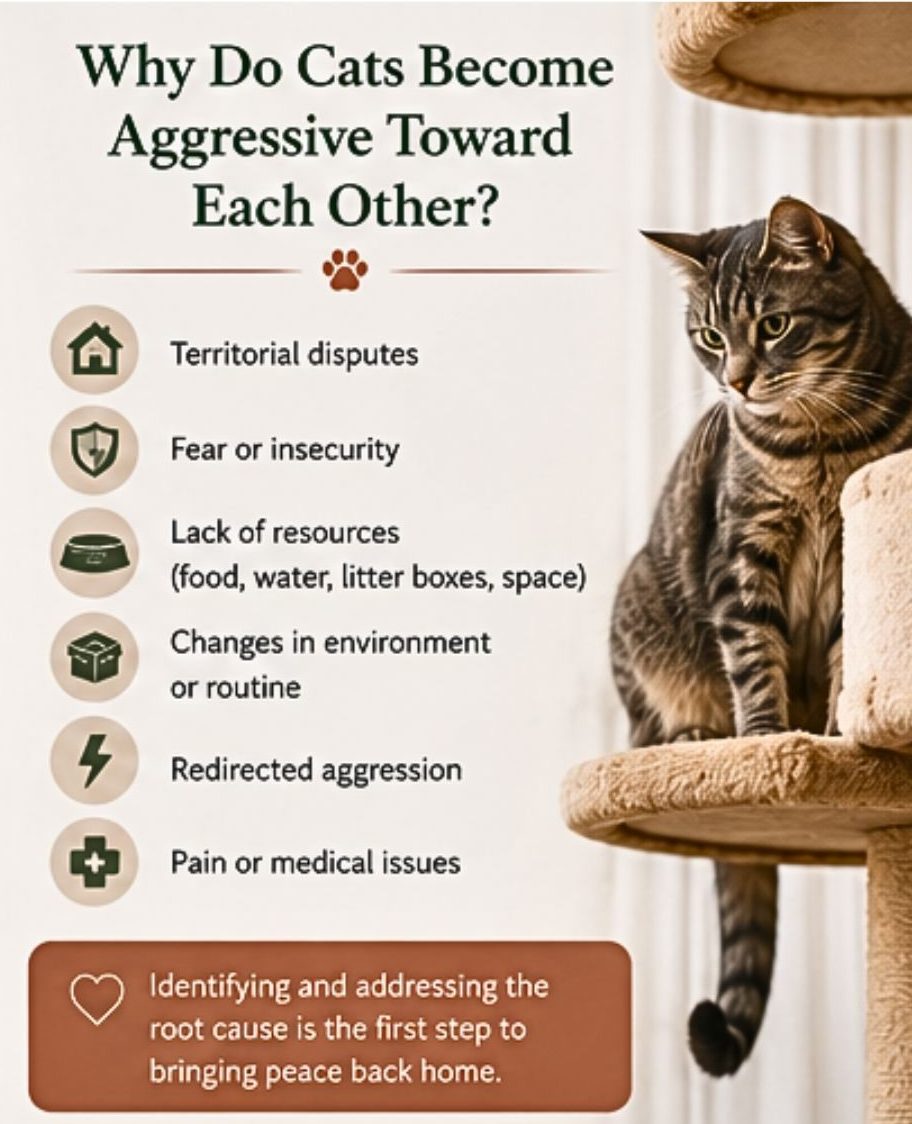
Cat aggression is not usually a matter of one cat being “bad,” “jealous,” or trying to become the “alpha.” Fear, frustration, incompatible social preferences, competition over important resources, unfamiliar smells, pain or illness, redirected arousal, and poorly managed introductions can all contribute.
The solution is rarely to make the cats “work it out.” Instead, the safest approach is to prevent further conflict, identify the trigger, reduce competition and stress, and—when necessary—reintroduce the cats gradually.
Important: Sudden behavior change can be caused or worsened by pain or illness. If aggression begins abruptly, is severe, causes injury, or is accompanied by changes in appetite, litter box use, activity, or other behavior, contact your veterinarian.
On This Page
- Quick Answer: Why Is My Cat Aggressive Toward My Other Cat?
- Are My Cats Playing or Fighting?
- Signs of Tension Between Cats
- Common Causes of Cat-on-Cat Aggression
- Territorial and Social Conflict
- Resource Competition and Blocking
- Fear-Based Aggression
- Redirected Aggression in Cats
- Cat Non-Recognition Aggression
- Why Is My Cat Suddenly Aggressive to My Other Cat?
- Aggression After Bringing Home a New Cat
- What to Do When Cats Fight
- What Not to Do
- How to Reintroduce Cats After a Fight
- Set Up the Home to Reduce Conflict
- When a Medical Problem May Be Involved
- When to Get Professional Behavior Help
- Can Cats Learn to Get Along Again?
- Frequently Asked Questions
- Related Cats Central Guides
- Sources and Further Reading
Quick Answer: Why Is My Cat Aggressive Toward My Other Cat?
A cat may become aggressive toward another cat because of fear, territorial or social tension, competition for resources, pain or illness, redirected arousal, an unfamiliar smell, or a stressful introduction.
Household cats do not automatically form a close social group simply because they live together. Some cats become bonded companions. Others coexist peacefully while keeping their distance. Some are poorly matched and experience ongoing tension unless the environment is carefully managed.
If the aggression is sudden, severe, or new between cats that previously got along, separate them and consider a veterinary examination before assuming the problem is purely behavioral.
Are My Cats Playing or Fighting?
Play between cats can look surprisingly dramatic. Cats may chase, pounce, wrestle, swat, and bite during normal play. The difference is usually found in the overall body language, reciprocity, and what happens afterward.
Signs the Cats May Be Playing
- Both cats willingly return to the interaction
- The cats take turns chasing or being chased
- Body posture is loose rather than rigid
- Claws are generally controlled
- There are natural pauses
- Neither cat is persistently trying to escape
- The interaction ends without prolonged hiding or avoidance
- The cats remain comfortable around each other later
Signs It May Be a Real Conflict
- One cat repeatedly pursues while the other tries to escape
- Growling, prolonged hissing, screaming, or yowling
- Rigid body posture
- Flattened ears or ears rotated sideways
- Puffed tail or fur
- Sustained staring
- One cat corners, blocks, or traps the other
- One cat hides for long periods afterward
- Access to food, water, litter boxes, resting places, or people changes after the interaction
- Injuries occur
A useful rule is to watch the cat who appears to be losing. If that cat voluntarily returns and re-engages with relaxed body language, the interaction may be play. If the cat is trying to get away, hiding, freezing, or avoiding the other cat later, treat the situation as tension rather than harmless play.
Signs of Tension Between Cats
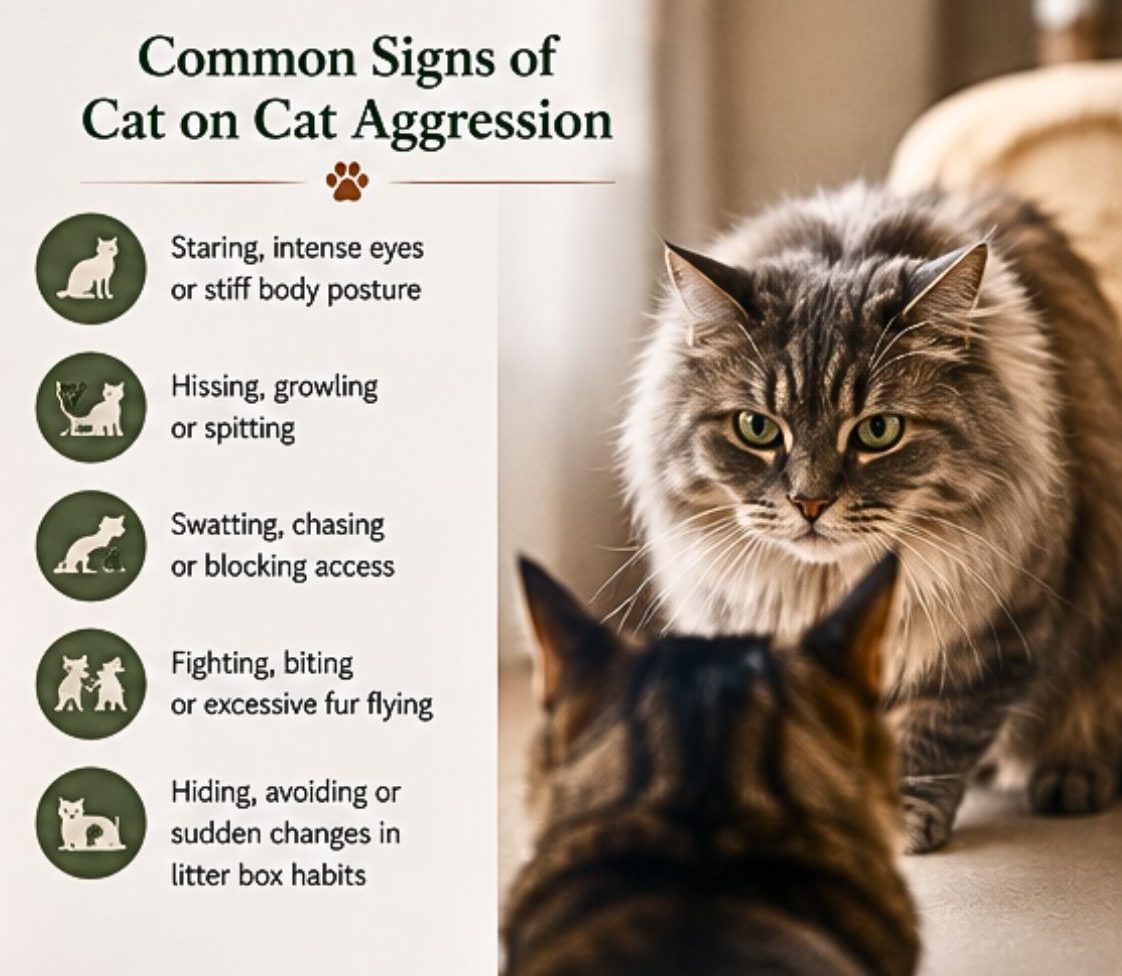
Intercat tension is often quieter than an actual fight. One of the most useful lessons from current feline behavior guidance is that owners may notice the frightened cat’s obvious hissing or swatting while missing the other cat’s quieter pressure.
Obvious Signs
- Chasing
- Swatting
- Biting
- Growling
- Hissing
- Yowling
- Physical fights
Subtle Signs
- Staring at another cat
- Blocking hallways, stairs, doorways, or litter box access
- Waiting outside a litter box
- Guarding food, water, beds, windows, or people
- One cat always leaving when the other enters
- One cat spending more time on high shelves or under furniture
- Reduced play or exploration
- Overgrooming or stress-related grooming changes
- Urine marking or house-soiling
- Changes in sleep locations
- A cat eating only when the other cat is absent
These quieter patterns matter because chronic stress can affect feline welfare even when there are no dramatic fights.
Common Causes of Cat-on-Cat Aggression
There is rarely one universal explanation for aggression between cats. The trigger may be obvious, or several smaller stresses may combine until the relationship deteriorates.
Common causes include:
- Incompatible personalities or social preferences
- Poor or rushed introductions
- Territorial or social conflict
- Insufficient or poorly distributed resources
- Fear
- Pain or illness
- Redirected aggression
- Non-recognition after a veterinary visit or other absence
- Seeing unfamiliar cats outside
- Changes in the household
- Competition for preferred resting or viewing locations
- Frustration or lack of enrichment
- Sexual or reproductive behavior in intact cats
The best treatment depends on the cause. Simply suppressing the visible fight without changing the underlying environment often allows the problem to return.
Territorial and Social Conflict
Cats are socially flexible animals. They can form friendships, but they do not automatically want close contact with every other cat they meet.
Some cats living in the same home belong to the same social group. They may groom each other, sleep touching, rub against one another, or seek each other out.
Other cats simply tolerate one another. They may share the house successfully because they can avoid conflict and access resources without interference.
Trouble can develop when a cat feels unable to maintain comfortable distance. A hallway, staircase, narrow doorway, single litter box, feeding station, or favorite window may become a point of conflict.
More Space Is Not Always the Whole Answer
A large home can still create tension if important resources are concentrated in one area. Conversely, a smaller home may work well when resources are distributed thoughtfully and cats have multiple routes, levels, hiding places, and resting choices.
The goal is to give cats options.
Resource Competition and Blocking
Resource competition does not always look like two cats wrestling over a food bowl.
A more confident cat may quietly sit in a doorway leading to the litter box. Another may stare at a cat while it eats. One cat may occupy the only comfortable high perch. The result can be avoidance even though no physical fight occurs.
Important Resources Include
- Food
- Water
- Litter boxes
- Resting and sleeping areas
- Scratching surfaces
- High perches
- Hiding places
- Windows and viewing areas
- Play opportunities
- Comfortable pathways through the home
- Positive interaction with people
Current feline environmental guidance emphasizes providing multiple, separated resources rather than expecting cats to share everything in one location.
What About Litter Boxes?
A commonly used starting guideline is one litter box per cat plus one additional box, placed in separate locations rather than lined up side by side. The exact number and placement should fit the household and the cats, but the principle is simple: no cat should have to pass or confront another cat to reach a toilet.
Fear-Based Aggression
A frightened cat may use aggression to create distance.
Fear-based behavior can include crouching, ears held sideways or back, dilated pupils, hissing, growling, swatting, retreating, or attacking when escape feels impossible.
Punishing a fearful cat can make the situation worse because the cat learns that the presence of the other cat predicts not only fear, but also punishment or frightening human behavior.
Instead, increase distance, provide escape routes, allow hiding, and work below the cat’s threshold of panic.
Redirected Aggression in Cats
Redirected aggression occurs when a cat becomes intensely aroused by something it cannot reach or respond to directly, then directs that aggression toward another available target.
Cornell’s Feline Health Center identifies common triggers such as:
- Seeing an outdoor cat through a window
- Loud or startling noises
- An altercation elsewhere in the household
- Other highly arousing events
Imagine an indoor cat staring through the window at an unfamiliar neighborhood cat. The indoor cat becomes highly aroused but cannot reach the intruder. A housemate walks past, and the aroused cat attacks that cat instead.
The victim cat may understandably fight back. Now both cats associate each other with a frightening event, and the conflict can continue even after the outdoor cat has disappeared.
What to Do After Redirected Aggression
Do not immediately force the cats back together. A highly aroused cat may take considerable time to settle.
Separate the cats in comfortable areas with their own resources. Allow visual and physical distance until both are calm. If they remain tense when reintroduced, use the gradual reintroduction process described later in this guide.
If outdoor cats repeatedly trigger incidents, consider reducing visual access to the triggering area with blinds, window film, landscaping, or other humane environmental changes.
Cat Non-Recognition Aggression
Few cat behavior problems are more bewildering than this one:
Two cats are close companions. One goes to the veterinary clinic. The cat comes home, and the housemate behaves as if a complete stranger has invaded the house.
This is often called non-recognition aggression.
Cats rely heavily on scent for social recognition. A returning cat may smell different because of disinfectants, medications, other animals, stress-related odors, grooming products, or simply being away from the household scent environment.
The returning cat may also move or behave differently because of sedation, pain, illness, or stress.
Signs of Non-Recognition Aggression
- Hissing or growling when the returning cat appears
- Staring or stalking
- Swatting or chasing
- The returning cat appearing confused or frightened
- A sudden fight despite a previously friendly relationship
How to Handle It
If tension is mild, additional distance and time may be enough. If either cat is highly aroused, separate them and reintroduce them gradually rather than repeatedly putting them together and hoping the problem disappears.
For cats with a history of post-veterinary conflict, discuss prevention with your veterinarian. In some households, bringing both cats to the clinic together or allowing the returning cat time to regain familiar household scent before reunion may help, although every pair is different.
Why Is My Cat Suddenly Aggressive to My Other Cat?
Sudden aggression deserves special attention because abrupt behavior change can reflect a medical problem, pain, or an external trigger.
Possible explanations include:
- Pain from arthritis, dental disease, injury, or another condition
- Illness changing a cat’s scent or behavior
- Reduced vision or hearing
- Neurologic disease
- Seeing an unfamiliar cat outside
- A frightening noise or event
- Non-recognition after a veterinary visit
- A recent household change
- A fight or stressful encounter that altered the cats’ relationship
- Competition that has gradually intensified
If cats that have lived peacefully together suddenly begin fighting, veterinary evaluation should be part of the plan—especially for older cats or when there are other changes in appetite, mobility, grooming, litter box habits, sleep, or sociability.
Aggression After Bringing Home a New Cat
Putting two unfamiliar cats together and waiting for them to “sort it out” can create a bad first impression that takes much longer to repair.
A new cat should usually begin in a separate transition room with:
- Food and water
- Litter box
- Bed or comfortable resting area
- Hiding places
- Scratching surface
- Toys and enrichment
Introductions should then progress gradually through scent exchange, positive associations near a closed barrier, controlled visual access, and eventually supervised time together.
The process is not a race. Some cats adjust quickly; others need days, weeks, or longer.
The goal is not necessarily to create best friends. Peaceful coexistence is a perfectly good outcome.
What to Do When Cats Fight
If two cats are actively fighting, your first priority is safety.
1. Do Not Put Your Hands Between Fighting Cats
A highly aroused cat may bite or scratch anyone nearby, including a familiar person. Cat bites can become infected and may require medical attention.
2. Create Distance Without Grabbing the Cats
If it can be done safely, interrupt visual contact or create a barrier so the cats can move apart. Once separated, place them in different secure areas and allow them time to settle.
3. Give Each Cat a Complete Set of Resources
Each separated area should contain water, food as appropriate, a litter box, hiding and resting locations, and enrichment.
4. Check for Injuries
Cat bite wounds can be small and easy to miss under fur. Contact a veterinarian if you suspect a bite, puncture wound, limp, swelling, pain, or other injury.
5. Identify What Happened Immediately Before the Fight
Ask:
- Was an outdoor cat visible?
- Did one cat just return from the veterinarian?
- Was there a loud noise?
- Were the cats near food, a litter box, doorway, or favorite perch?
- Was one cat already frightened or excited?
- Has either cat been acting ill or painful?
Finding the trigger helps determine whether you need simple recovery time, environmental changes, veterinary care, or a full reintroduction.
What Not to Do
Several common responses can increase fear and make cat-to-cat conflict worse.
- Do not punish either cat. Yelling, spraying water, hitting, or frightening a cat can increase stress and create additional negative associations.
- Do not force face-to-face contact. Holding cats near each other prevents escape and may intensify fear.
- Do not carry one angry cat toward the other.
- Do not assume the hissing cat started the problem. The more frightened cat may be the one making the most noise while responding to subtle pressure from the other cat.
- Do not repeatedly test them while they are still aroused.
- Do not remove all hiding places. Safe retreat options reduce conflict.
- Do not make them share one food bowl or one litter box to “teach” cooperation.
The goal is to change how the cats feel about the situation, not simply to stop the visible behavior for a moment.
How to Reintroduce Cats After a Fight
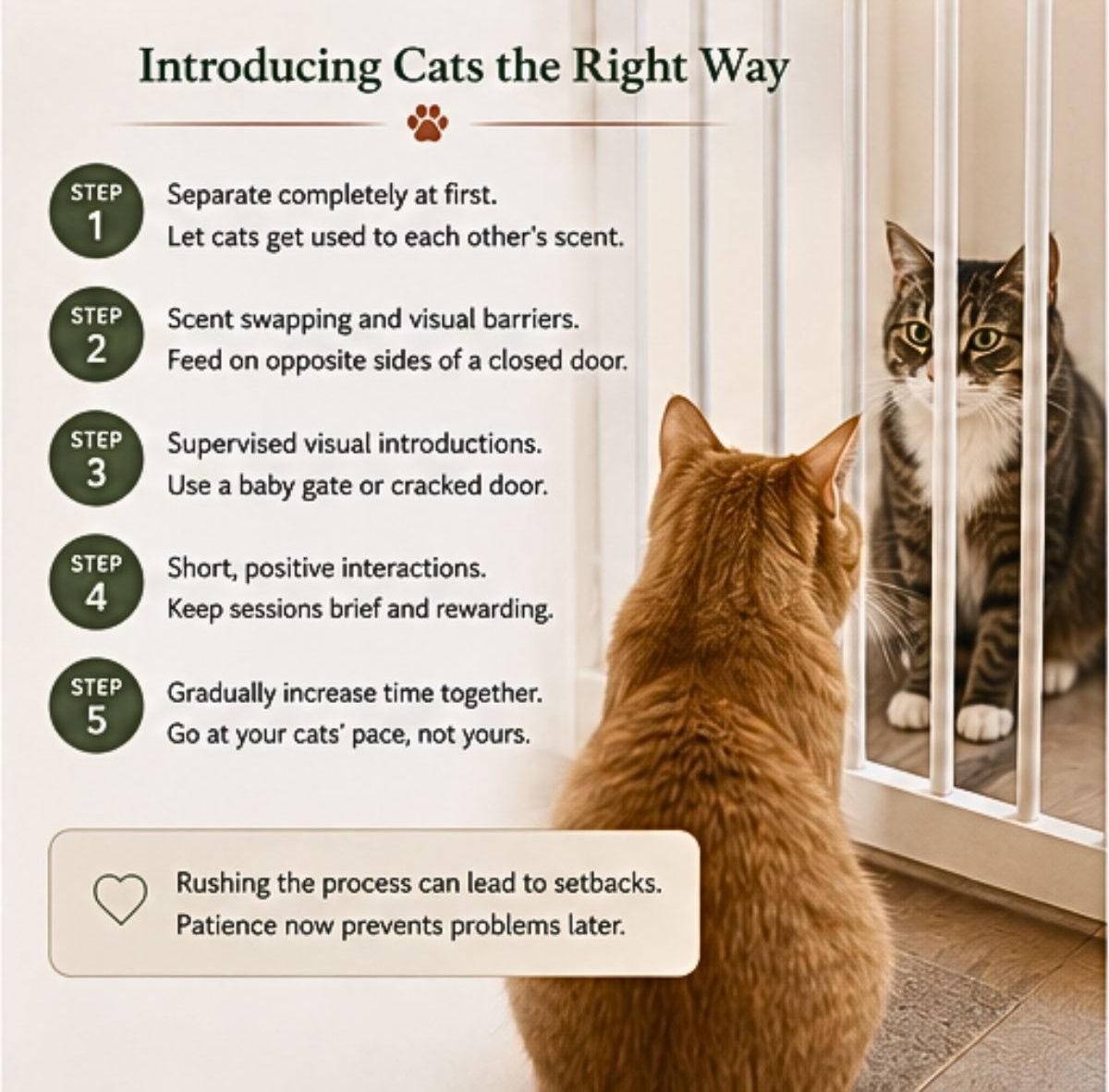
If cats remain tense after an incident, treat them as though they are being introduced again.
A gradual reintroduction can prevent repeated fights from becoming a rehearsed pattern.
Step 1: Separate and Let Everyone Decompress
Place the cats in separate comfortable areas. Wait until both cats are eating, playing, resting, grooming, and behaving normally in their own spaces.
Step 2: Build Positive Scent Associations
Allow the cats to investigate bedding or other scent-bearing items from the other cat when they are relaxed. You can also rotate access to rooms so each cat encounters the other’s scent without direct confrontation.
Do not force a scented object into a frightened cat’s face.
Step 3: Create Positive Experiences on Opposite Sides of a Closed Door
Feed meals, offer treats, or provide play at comfortable distances from the closed door. The cats should remain relaxed enough to eat or engage.
If either cat stares at the door, growls, refuses food, or becomes tense, increase distance.
Step 4: Introduce Controlled Visual Contact
When both cats are consistently relaxed near the closed barrier, allow brief visual access using a secure setup that prevents rushing or fighting.
Keep sessions short and positive. End before either cat becomes highly aroused.
Step 5: Allow Short Supervised Sessions
Once visual sessions are calm, allow brief time in the same space with multiple escape routes, high perches, and plenty of distance.
Reward calm behavior. Do not place the cats side by side or expect them to interact.
Step 6: Increase Time Gradually
As the cats demonstrate relaxed behavior, slowly extend their shared time. A setback does not mean failure; return to an earlier stage and proceed more slowly.
What Does Success Look Like?
Success may mean the cats groom and sleep together. It may also mean they simply pass one another without tension and comfortably use different parts of the home.
They do not need to become best friends to have a good quality of life.

Set Up the Home to Reduce Conflict
The physical environment can either increase or reduce cat-to-cat tension.
Distribute Resources
Place key resources in multiple locations so one cat cannot control access to everything from a single position.
Add Vertical Space
Cat trees, shelves, window perches, and other elevated locations increase usable territory and give cats more ways to avoid one another.
Create Multiple Pathways
A cat should not routinely have to squeeze past another cat in a narrow hallway or doorway to reach food, water, a litter box, or resting area.
Provide Hiding and Retreat Options
Boxes, covered beds, furniture arrangements, and other safe retreats allow a cat to disengage instead of escalating a confrontation.
Feed Cats With Appropriate Separation
Some socially bonded cats are comfortable eating near one another, but many cats prefer more space. Separate feeding areas can reduce staring, stealing, rushing, and competition.
Give Each Cat Individual Play
Interactive play can provide an outlet for hunting behavior and reduce frustration. Cats with different ages or activity levels may need different play styles.
Protect Rest
Make sure each cat has places where it can sleep undisturbed.
Watch Windows
If neighborhood cats repeatedly trigger redirected aggression, manage the visual trigger rather than allowing the same conflict to occur again and again.
When a Medical Problem May Be Involved
Behavior and health cannot be separated neatly.
Pain can shorten a cat’s tolerance for touch, play, or another cat approaching. Illness may change how a cat smells or moves, affecting how a housemate responds.
Medical problems that can contribute to behavior change include:
- Arthritis or other pain
- Dental disease
- Injury
- Urinary tract discomfort
- Hyperthyroidism
- Neurologic disease
- Vision or hearing loss
- Other illnesses that change activity, scent, or tolerance
A veterinary examination is particularly important when:
- Aggression begins suddenly
- An older cat’s behavior changes
- One cat appears painful
- Appetite or weight changes
- Litter box habits change
- Grooming decreases or increases dramatically
- A cat becomes unusually withdrawn
When to Get Professional Behavior Help
Some cat relationships improve with environmental changes and a patient reintroduction. Others need individualized help.
Ask your veterinarian for behavior support when:
- There are repeated physical fights
- Either cat has been injured
- One cat is chronically hiding or avoiding normal activities
- A cat cannot reach food, water, or litter boxes comfortably
- Urine marking or house-soiling develops
- Redirected aggression keeps recurring
- Reintroduction attempts repeatedly fail
- The cats’ quality of life appears poor
- People in the home are at risk of being bitten or scratched
A veterinarian with a special interest in behavior or a board-certified veterinary behaviorist can evaluate medical and behavioral contributors together. A qualified feline behavior professional may also help with environmental management and reintroduction under veterinary guidance.
Medication is sometimes part of a behavior treatment plan, particularly when fear or anxiety is severe, but medication should be prescribed for the individual cat and used alongside environmental and behavior modification—not as a substitute for them.
Can Cats Learn to Get Along Again?
Often, yes.
A single fight does not necessarily destroy a cat relationship permanently. Many pairs can return to peaceful coexistence when they are given time to calm down and are reintroduced carefully.
The outlook depends on:
- The cause of the conflict
- How long the tension has existed
- Whether serious injuries have occurred
- How frightened each cat has become
- Whether the household can provide enough separated resources and space
- Whether pain or illness is contributing
- How gradually the reintroduction is managed
Some cats will become affectionate companions again. Others may need permanent environmental management and more personal space.
In difficult cases, the humane goal is not to force friendship. It is to create a living arrangement in which every cat can eat, sleep, eliminate, play, explore, and interact without chronic fear.
Frequently Asked Questions About Cat-on-Cat Aggression
Why is my cat suddenly aggressive to my other cat?
Sudden aggression may be triggered by pain or illness, an unfamiliar outdoor cat, a frightening event, redirected aggression, non-recognition after a veterinary visit, or a change in the household. Separate the cats if needed and arrange veterinary evaluation when the change is abrupt or unexplained.
Why are my cats suddenly fighting after getting along for years?
Look for a recent trigger such as illness, pain, a veterinary visit, an outdoor cat at the window, a startling event, or environmental change. Aging can also alter mobility, vision, hearing, or tolerance. Cats with a previously stable relationship can often recover, but repeated fights should be prevented while you investigate the cause.
What is redirected aggression in cats?
Redirected aggression happens when a cat becomes highly aroused by a stimulus it cannot reach and attacks another nearby cat or person instead. Seeing an unfamiliar cat outside is a classic trigger.
What is cat non-recognition aggression?
Non-recognition aggression occurs when a familiar cat is temporarily treated like a stranger, often after returning from a veterinary clinic or other absence. Changes in scent, movement, stress, sedation, or illness may contribute.
Should I let my cats fight it out?
No. Allowing repeated fights can increase fear, cause injury, and strengthen negative associations between the cats. Separate them safely and address the underlying cause.
How long should I separate cats after a fight?
There is no fixed number of hours that works for every situation. Keep them separated until both cats have returned to relaxed normal behavior. After a severe fight, a structured reintroduction may be needed rather than a simple reunion.
How can I tell if my cats are playing or fighting?
Play is usually reciprocal and includes pauses and role reversals. In genuine conflict, one cat often tries to escape while the other continues pursuing, and tension may persist after the interaction ends.
Why does one cat keep staring at my other cat?
Sustained staring can be a subtle form of social pressure or tension. Pay attention to what the other cat does: leaving the room, freezing, hiding, or avoiding resources suggests the stare may be meaningful rather than neutral.
Why does my cat attack another cat after seeing a cat outside?
This is a common pattern of redirected aggression. The indoor cat becomes highly aroused by the outside cat but cannot reach it, so the aggression is redirected toward a nearby housemate.
Why did my cat attack my other cat after a vet visit?
The returning cat may smell unfamiliar or behave differently because of stress, medication, sedation, illness, or clinic odors. This can trigger non-recognition aggression.
Can pheromone diffusers stop cats fighting?
Feline pheromone products may be useful as one part of an overall tension-reduction plan for some households, but they should not replace adequate resources, separation when needed, gradual introductions, medical evaluation, or behavior treatment.
Do cats fight because they are trying to establish dominance?
The idea of a simple household “alpha cat” hierarchy is not a useful explanation for most intercat conflict. Social compatibility, fear, access to resources, space, and individual relationships provide a more useful framework.
Can two cats that hate each other ever live together?
Some severely conflicted cats can improve considerably with environmental changes and careful reintroduction. Others may never become friends but can learn to coexist with enough space and separate resources. A behavior professional can help assess difficult cases.
Should I punish the aggressive cat?
No. Punishment can increase fear and arousal and may worsen the cats’ association with each other. Focus on separation, prevention, environmental management, and reward-based behavior work.
When should I call the veterinarian?
Call your veterinarian when aggression begins suddenly, injuries occur, a cat appears painful or ill, litter box or appetite changes develop, or the conflict is severe or persistent.
Related Cats Central Guides
Recommended future supporting articles: Introducing Cats to Each Other, Multi-Cat Households, Cat Stress and Anxiety, Cat Body Language, Redirected Aggression in Cats, and Cat Non-Recognition Aggression.
The Bottom Line
Cat-on-cat aggression is rarely solved by deciding which cat is the troublemaker.
Look instead at the relationship between the cats and the environment around them. Are both cats able to move through the home comfortably? Can they eat, drink, sleep, play, and use the litter box without being watched or blocked? Did a frightening event occur? Is one cat in pain? Was a new cat introduced too quickly? Is an outside cat repeatedly triggering arousal?
Once serious medical problems are addressed, the most effective strategy is usually to reduce conflict, increase access to separated resources, provide choice and escape routes, and rebuild positive associations at a pace both cats can handle.
Your cats do not have to sleep in a furry heap to be successful housemates. If each cat can live comfortably without fear, pressure, or repeated conflict, that is a very good outcome.
Sources and Further Reading
- Feline Veterinary Medical Association / AAFP: 2024 Intercat Tension Guidelines
- Cornell Feline Health Center: Feline Behavior Problems — Aggression
- Feline Veterinary Medical Association: Meeting the Physical and Emotional Needs of Indoor Cats
- Feline Veterinary Medical Association: Are You Thinking of Getting Another Cat?
- AAFP Feline Behavior Guidelines
Behavior and veterinary note: Cats Central provides general educational information. Sudden aggression, injuries, severe fear, or persistent conflict should be discussed with a veterinarian. Individual cats and households may require a personalized behavior plan.
Last reviewed: August 2026